By Harris Vaughan
On a spring day, the kind of day that wakes the soul, Dell Murphy and Jeff Turner are visiting a 100,000-square-foot building situated 11 feet above the waterline on the edge of the Albemarle Sound outside of Edenton, North Carolina. It’s 2015, and they’re about to merge two rival boat companies that have been building nearly identical sport fishing vessels a mile apart for 25 years.
But this isn’t really about business deals or even boats, exactly. It’s about water — the kind of water that builds better boats, and the kind of people who refuse to let rough seas sink them.
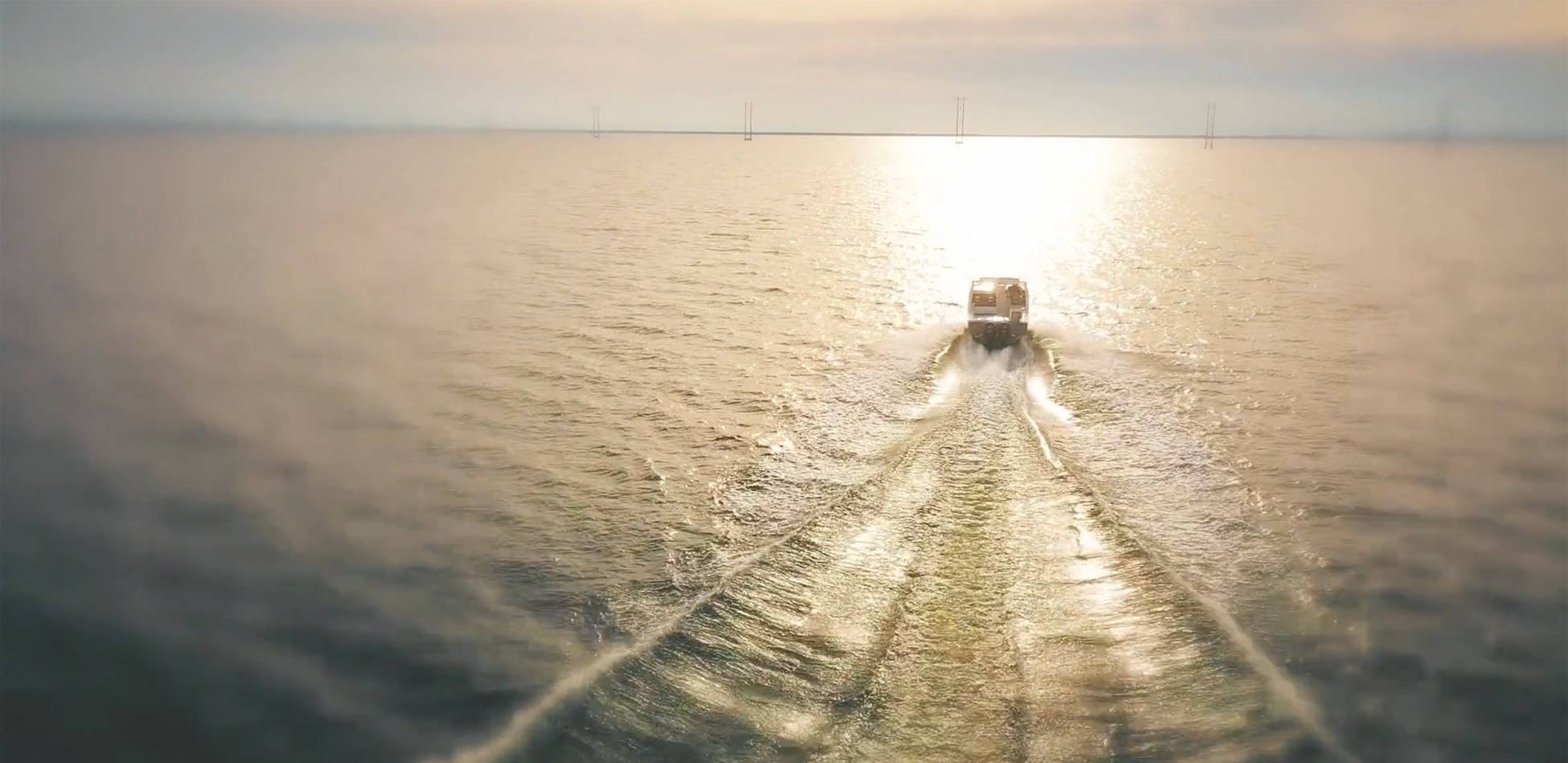
If you’ve never crossed the Albemarle Sound on the Intracoastal Waterway, you might not understand why this particular body of water matters. It’s the largest brackish estuary in North America. Boaters transiting from north to south will tell you it’s one of the roughest inland waterways, too. Driven by the wind, 6-foot seas can stack close together on a rough day and then lay flat as a lake on a calm one.
“That rough water makes better boats,” Burch Perry, of Albemarle Boats, says, standing in the same building where Chris-Craft once tried and failed to build boats in the late 1960s. “If it’s going to break, I want it to break here.”
It’s the philosophy that has driven Albemarle Boats since 1978. That’s when Burch’s grandfather, Scott Harrell, and his fishing friend and eventual business partner, Mac Privott, were literally breaking apart Fiberform runabouts fishing off Hatteras Island, the hulls cracking loose from the decks. Those cheap West Coast boats weren’t built for North Carolina’s waters. So, they made their own.
The first Albemarle was built in the back of a tractor shop in Edenton, a town that’s been shaping American history since Colonial times. It’s a place where commercial fishermen became charter boat captains who later became boat builders — crafting boats sturdy enough to cruise out to the Gulf Stream and back. Every boat bearing the Albemarle name since 1978 has been tested in the sound with the same name. Every. Single. One.
Around 1990, after building Albemarle Boats together, Scott Harrell and Mac Privott decided to go their separate ways. Mac started Carolina Classic while Scotty Harrell, Scott’s son and Burch’s uncle, stepped in to run Albemarle. What followed was 15 years of strong growth and friendly competition — Burch working for his uncle at Albemarle, Keith and Wade Privott working for their father at Carolina Classic. Two families with two brands of boats so similar that even they couldn’t tell them apart from half a mile offshore.
What they didn’t know, could not have foreseen, was that those two boat brands were among the few competitors that would survive. When the Great Recession hit in 2008, Rampage went under. Cabo got mothballed. Bertram shuttered for a while. The fate of every major boat builder hung in the balance while these two North Carolina companies held on through the storm.
Brunswick had purchased Albemarle in 2005, and Scotty Harrell retired a year later. When the recession hit, Brunswick started locking gates. Entrepreneur Scott McLaughlin bought Albemarle on Dec. 31, 2008, then Carolina Classic two years later. They built 14 different models between the two companies, barely surviving.
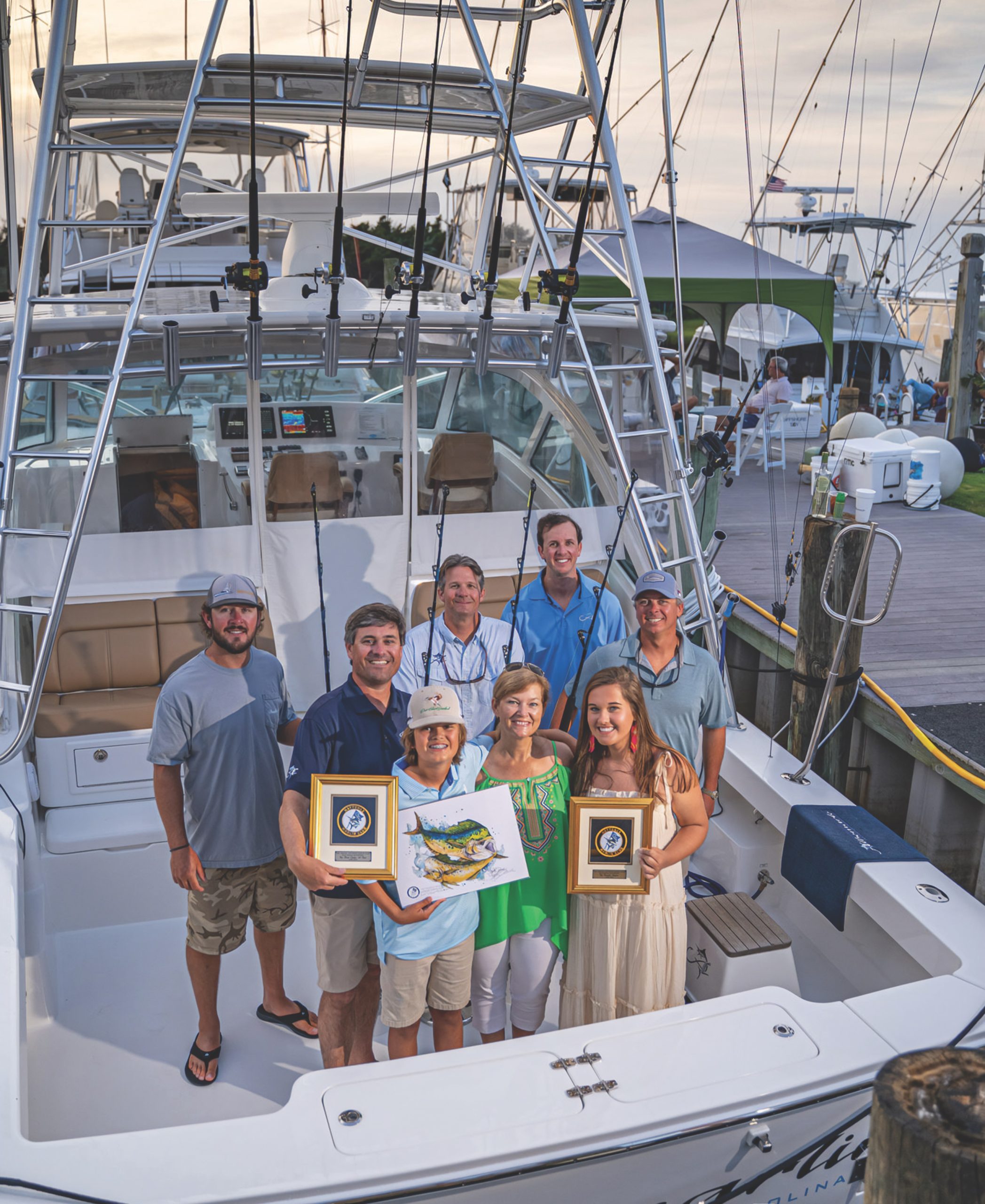
Then, in 2015, the Murphy family arrived. By May they’d purchased both companies and merged them, naming Burch Perry as general manager, Keith Privott as director of sales and product development, and Wade Privott as production manager.
Dell Murphy’s son Wen, barely out of high school, sketched the combined logo on a cocktail napkin — the fishhook “C” from Carolina Classic woven into the Albemarle “A.” At that moment, “Albemarle, The Carolina Classic” was born.
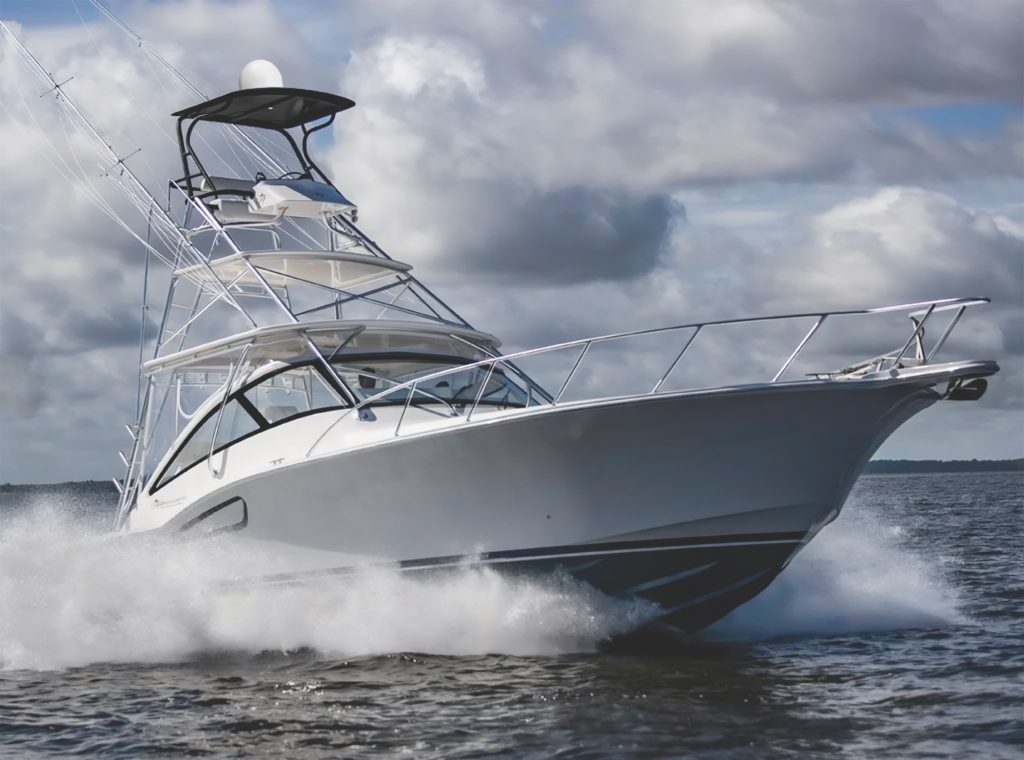
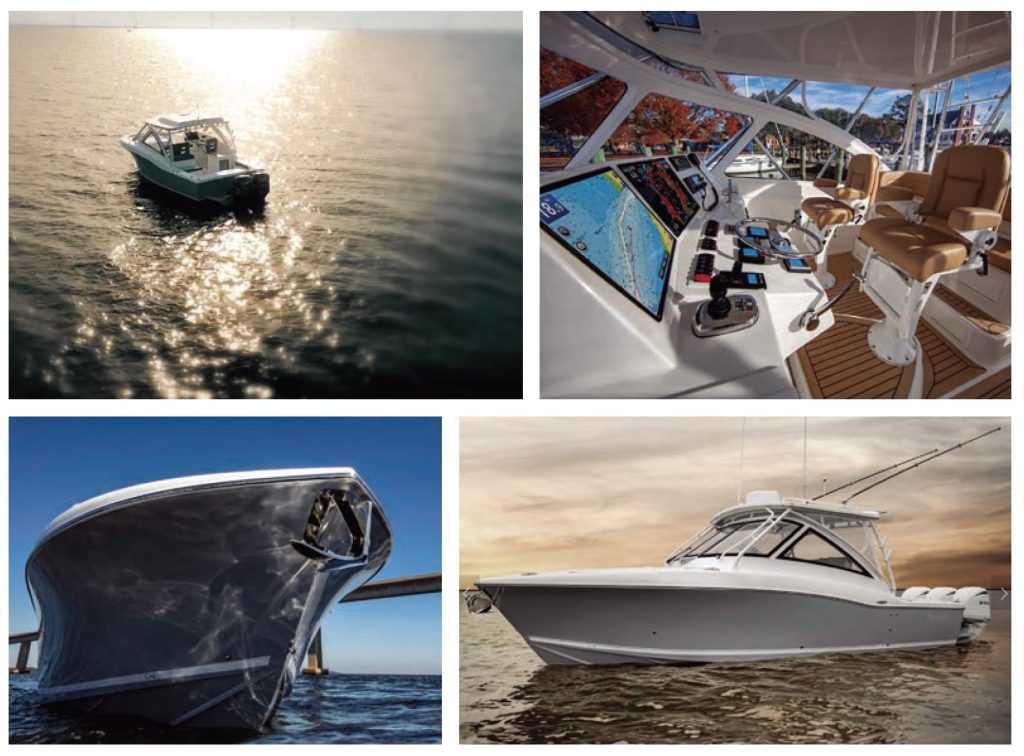
Fresh eyes matter. Local knowledge matters. The ability to navigate rough water matters most of all. Walk into Albemarle today and you’ll witness a marriage of cutting-edge technology and ancient craftsmanship that produces boats purchased by clients from the Philippines to Turkey, Lake Michigan to the Mediterranean Sea.
Marine architects create 3D computer-aided design models. The files go to Sarasota, Florida, where a five-axis computer numerical control router cuts foam into exact boat hull shapes, accurate to 3/1000 of an inch — the width of a human hair. What used to take months now takes a day.
“A hardtop builder was pulling measurements,” Keith recalls, “and said, ‘This side’s about 1/16 longer.’ I told him his tape measure was broken.”
But technology can’t sand that plug to a mirror finish. Can’t know a hatch should open differently. Can’t feel when the fiberglass layup is right. For that, you need people.
You need the crew in lamination, many from the Outer Banks, building parts in heat and fiberglass dust. You need cabinet makers crafting custom interiors where every boat gets different wood, fabric, layouts. You need the souls who’ve been there for three decades or longer, who know without asking whether something’s good enough. They build them “like they’re going to fish on them themselves,” Burch says.
Parts arrive from everywhere — Yamaha outboards from Japan or Mercurys from Wisconsin, Cummins diesels from Rocky Mount, Volvo Pentas from Sweden, MTUs from Germany, and fabrics from around the globe. But the fiberglass work, cabinet building, wiring, finishing — that’s all local hands turning global components into something that can survive anywhere.
After months or years of work comes “splash day,” when a new boat touches water for the first time. Equal parts celebration and terror. When they can, they bring guys from lamination who’ve never seen the finished boat and put them on the Albemarle Sound when it’s blowing 20 knots, let them feel what their work becomes bouncing through nasty seas. Last year, a customer from northern Virginia who knew the builders by name said: “I’m taking this boat to Pirate’s Cove. I want to take the guys who built my boat fishing.” And he did.
There’s a doctor in Fort Lauderdale with a tackle room full of antiques — rods that belonged to Ernest Hemingway and Zane Grey. On his wall hangs a framed foreign newspaper Burch can’t read, but the photo’s clear: a man beside a 700-pound marlin caught in French Polynesia.
“He learned about Albemarle from a 28-footer we built in 1998 for Tahiti,” Burch says. “Twenty years later, he’s building a 36-footer with us.”
The boats go everywhere. One’s making a 1,900-nautical-mile journey across Southeast Asia. They’re on Lake Michigan and the Gulf Coast, in Italy and Japan, wherever people need a boat that won’t quit when the water gets mean.
Albemarle boats range from $300,000 to north of $4 million now. Semi-custom means every boat is slightly different because customers put their fingerprints on it. A Lake Michigan customer built three 41-footers in 4 1/2 years. On splash day, he’d cater lunch for the employees who built them — Leon Nixon Barbecue one time, crab cakes the next.
The waters of the Albemarle Sound aren’t going to change. And neither will its people. They understand that the place shapes the boat, the boat shapes the experience, the experience shapes the people who come back and build another one, even better than the one before.
“If it’s blowing 20 knots and the truck’s coming to pick it up, we’ll run it,” Burch says. “That’s when you learn what you built.”
Eighty-five people show up every day to a building 11 feet above sea level in a town that’s shaped eastern North Carolina since before it was a state. They make fiberglass dust, sand parts, wire electronics and craft cabinets. Most will never own what they build. Some have never fished offshore. But on splash day, when that boat touches water and heads out into the sound that has broken lesser vessels, they know somewhere someone’s pulling a marlin aboard an Albemarle.
“We love what we do because every day is a challenge,” says Keith. “You start with an idea, then it comes into this building as resin in a drum. And then you’re out there on the water, running that boat for the first time. That’s a sense of accomplishment.”
It’s not just a boat story. It’s a water story. A people story. A story about what happens when you refuse to sink, when, in coming back together, the ride gets smoother, even in choppy seas.