
By Susan Campbell
If you’ve spent much time in wet areas in the Coastal Plain during the cooler months, you have no doubt noticed plenty of big white birds. Great egrets, about the size of great blue herons, wade in shallow water that is either fresh or salty, stabbing at fish with their long dagger-like bills. Snowy egrets — as well as the white form of the little blue heron and the reddish egret — do the same but, given their smaller stature, tend to forage for frogs, crabs and other more diminutive prey. Flocks of white ibis, invariably with gray-plumaged youngsters, seem to prefer wet, grassy areas, probing for worms with their long, reddish, curved bills. And there are large, light-colored waterfowl like tundra swans and snow geese that graze on aquatic vegetation.
There is, however, another big white bird that’s becoming more numerous each year and can be seen from the sounds to the larger, coastal lakes like Mattamuskeet: the American white pelican.
We are all, no doubt, familiar with the lumbering brown pelican, which can be seen soaring just above the waves in small groups all along the coast during the warmer months. Most of our browns head farther south when the mercury drops, spending the colder months in Florida and elsewhere in the Gulf states. White pelicans, by comparison, are bigger and heavier birds that are primarily observed here in the winter. They breed in wetlands far inland in the western United States but nowadays show up in eastern North Carolina. Two decades ago, it was a thrill to glimpse a few of these majestic birds. Seeing them in a couple of dozen places, or more, this time of year is now almost expected.
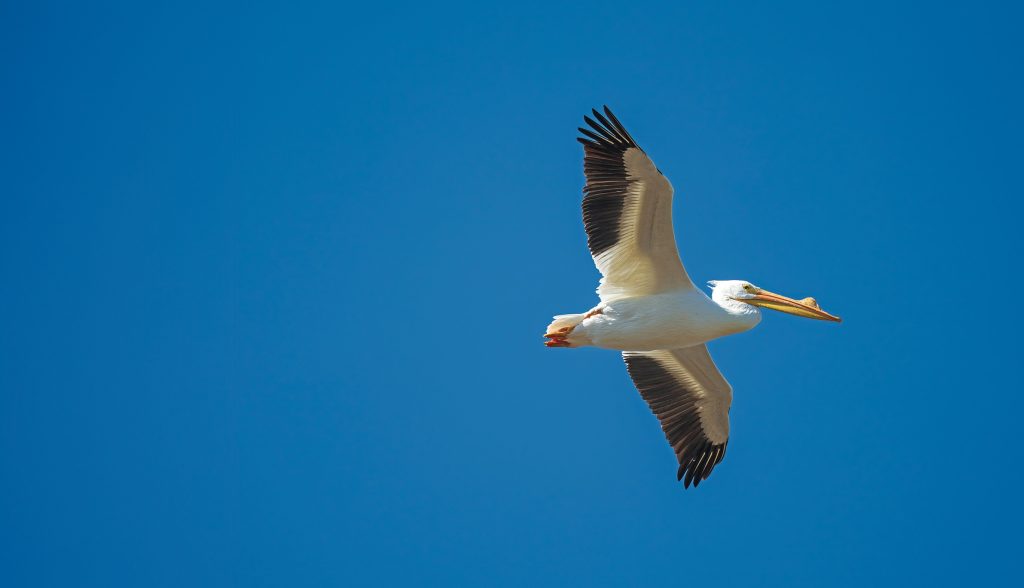
White pelicans are unmistakable in flight with their massive wingspan and black wing tips. One of the largest birds in North America, these amazing pelicans are expert soarers, flying long distances on mostly outstretched wings, in classic V-formation. Their huge, orange bills as well as orange legs and webbed feet are distinctive. The highly specialized pouch in their lower mandible allows them to capture and swallow large mouthfuls of their favorite food: small bait fish like menhaden. They’re also opportunistic feeders, taking a variety of abundant aquatic prey depending on the season and water depth.
Unlike their brown cousins, white pelicans do not dive but dip and grab food items with their large mouths. Several individuals may group together to herd schools of fish into shallows, where they are trapped and easily scooped up by the line of birds. In addition to active fishing, these birds are known to steal prey from each other as well as from other seabirds, such as double-crested cormorants, a frequent associate.
Though they are typically visual predators, white pelicans may also feed at night. This is more likely on the breeding grounds when nocturnal fishing can yield the larger fish they require to support growing families. These birds also routinely move tens of miles in a day, going from place to place plying the water for their next meal.
White pelican populations have rebounded significantly over the last half-century. Their numbers are now way up from the days when they were persecuted for perceived competition with fishermen. Habitat loss and human disturbance are still issues facing them — especially on the breeding grounds — but for those of us in eastern North Carolina, it’s a winter treat to see these majestic birds in our skies and on our waters.