
By James Dodson
“The high points of my life have all been journeys,” allows Scott Huler. “Just being outside and seeing what he might have seen on his incredible travels across an unexplored Carolina was one of the biggest thrills of my life.”
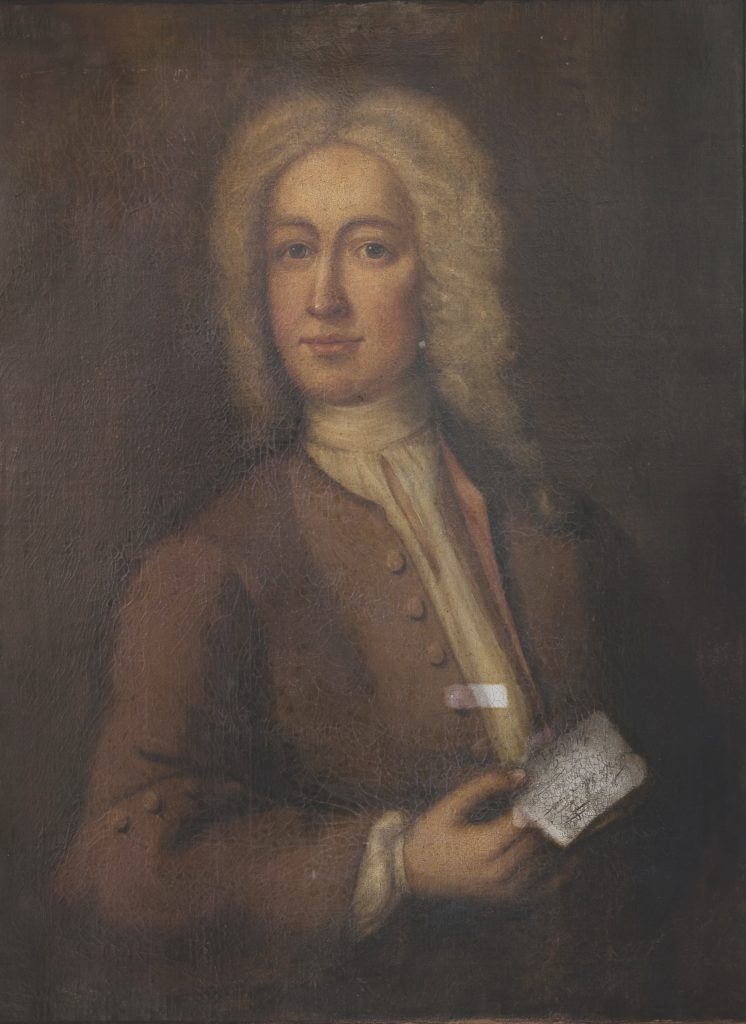
The he Huler speaks of was a well-bred English gentleman named John Lawson, a young and intrepid adventurer with apparent scientific credentials who was appointed to be Surveyor General of North Carolina by the British Crown in August 1700. Three days after Christmas that year, Lawson set off from Charles-Town with a party of five Englishmen and several Indian guides on an ambitious expedition to explore the wilderness of the Colony of North Carolina, which at that moment comprised the geography of both modern North and South Carolina.
Canoeing through tidal marshes and up the Santee and Wateree rivers of South Carolina, the Lawson expedition entered North Carolina on foot in the proximity of modern Charlotte (then an Indian village called Keyauwee), encountering and studying flora and fauna and peaceful Native Americans that included the Esaw, Sugaree and Catawba Indians.
From there, the expedition followed the ancient Trading Path used by native tribes for millennia in a northeasterly fashion to the village of Occaneechi Town – soon to be the Colonial settlement of Hillsborough. At that point, Lawson and a trusted guide named Enoe Will headed due east to the coast, crossing the Neuse River and fording the Tar River at a point beyond what is now Greenville. The expedition reached the English settlement on the “Pampticough” River on February 23, in the vicinity of Little Washington.
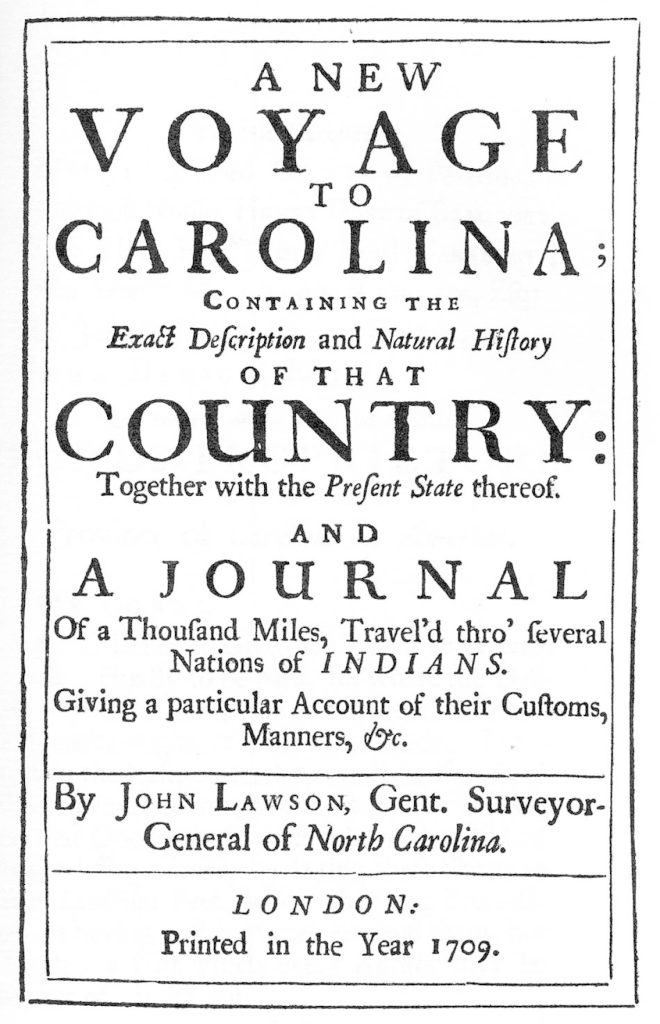
Lawson’s ambitious loop from coast to coast across the Carolina backcountry took 59 days and covered an estimated 550 miles of wilderness largely unexplored by Europeans. In 1705, by an act of the Colony’s General Assembly, he purchased 60 acres on Bath Creek from local Indians and fellow European stakeholders to incorporate the Colony’s first town of Bath, which by 1708 boasted a gristmill and 12 houses. The next year, Lawson returned to London to supervise the publication of A New Voyage to Carolina, an extensive account of his journey through Carolina backcountry that featured detailed observations of the customs and beliefs of the Colony’s Native American populations, as well as impressive cataloging of the natural history of North (and future South) Carolina.
In the rapidly emerging Age of Exploration, Lawson — a son of privilege whose family enjoyed connections to British royalty — was clearly out to make a name for himself, but his intimately detailed and highly readable “history” quickly became a bestseller in England and across Europe at large; translations in French and German soon followed. Today, his backcountry exegesis is still regarded as one of the best travel accounts to appear from the early 18th century American Colonies.
Moreover, while home in London, Lawson remained active in North Carolina’s Provincial affairs by representing the Colony in a bitter boundary dispute with Virginia that took many years to resolve. He also organized a group of Swiss and Palatine Germans to settle on the Neuse and Trent rivers in 1710, co-founding the town of New Bern with their leader, Baron Christoph Von Graffenried. Lawson built his own house on a “high and pretty piece of land” beside a lively stream that is still known as Lawson’s Creek today. A public park in present day New Bern bears the name of the city’s intrepid founder.
In September 1711, Lawson invited Von Graffenried to accompany him on a trip up the Neuse River to what is now Contentnea Creek near the modern town of Grifton at a moment when tensions with the powerful Tuscarora Indians were growing from decades of dispossession and slavery at the hands of Colonists. Theirs would be a fatal journey. Lawson’s party was captured by the Tuscarora Indians, ritually tortured and reportedly burned to death by their captors. Von Graffenried was eventually set free to provide the only account of his famous companion’s grisly death. Many believe this was the spark that ignited the Tuscarora War a short time later.
Though word of Lawson’s adventure faded over subsequent centuries, as his modern day fellow explorer Scott Huler makes clear in his delightful 2019 book A Delicious Country, Lawson’s vivid descriptions of the land and sympathetic approach to the native people he met on his travels remain a valuable record of unexplored North America. Moreover, his impressive collections of natural specimens — many unique to North America — found their way into Britain’s Museum of Natural History, where they can be viewed to this day. Because he founded the state’s first two towns — Bath and New Bern — Lawson has been called “North Carolina’s first citizen.”
“The fact that almost no one today knows about Lawson’s journey was a major motivation to me,” confirms Huler over a fried bologna sandwich at his favorite pub on Ninth Street in Durham, 326 years after Lawson’s trek. “Even I had never heard his story and more or less discovered it while working on another book.”
Huler credits his 2010 book, On the Grid, with bringing about his own Lawson awakening. It’s a witty and detailed examination of the various “systems above and below ground” of his house in Raleigh’s Five Points neighborhood.
“While I was researching the part on the lay of the land where our house sits, I got interested in traveling back to understand what my little piece of property might have looked like way back before Europeans arrived here,” Huler says. “I started going backward through pages and pages of documents of historic land transactions, all the way back to Colonial times, and kept running into a sentence that read ‘Lawson walked through here.’ I wondered who this guy Lawson was.”
When he finally got his hands on a copy of Lawson’s A New Voyage to Carolina, a lightbulb went off in Huler’s head to research and faithfully retrace the Englishman’s path from Charles-Town to Bath and New Bern. “To see what the places he traveled through look like today.”
Historic travel adventures were hardly a new thing to this veteran NPR reporter and Duke Magazine staff writer. Huler’s seven books include an ambitious odyssey through the ancient and modern Mediterranean following the path of Homer’s Odyssey; a charming stroll through American maritime history in quest of the enigmatic Beaufort Scale; plus, his yeoman’s examination of civic systems above and below our suburban plots of land that make the world around us function.
After snagging a prestigious MIT project fellowship and lining up a band of natural history experts and local naturalists who knew the lay of the land where he planned to travel, Huler was off paddling and walking in mid-October 2014 — finishing his quest just under a year later in the town of Bath.
“Unlike Mr. Lawson,” he explains with a smile over lunch, “I had the modern life of a parent to keep up that included a Sunday School carpool to manage and mini-mites soccer games to attend. So, I went bit by bit, like an Appalachian Trail through-hiker would do.”
Huler’s first challenge came as he attempted to navigate his canoe through the vast and gorgeous coastal spartina marshes and coastal creeks on his way to the mouth of the Santee River in the company of a local outdoor guide and naturalist named Eliabeth Anderegg. “We pushed off from where Lawson did, and I immediately had a seminar in battling the coastal winds and currents. Elizabeth was in a kayak but I was in ‘a pack mule of a craft,’” he writes, “loaded with a cooler full of food, a 17-gallon container of water, a tent, flares, an emergency satellite phone, and several dry bags full of clothes, books, maps and electronics . . . it was exhausting. I was essentially a human sail being blown off course by winds, tides and currents, one of the toughest things I had to do on the Trek.”
One of his first conclusions from this opening experience was that Lawson never paddled his own canoe. “He writes that he was in a large canoe with ten people including his native guides, making notes as he went; he never mentions the strong winds and tides, which clearly indicates that others paddle his canoe.”
On the plus side, like his predecessor, Huler found the spartina marshes he passed through mesmerizingly beautiful. “For a week, I see nothing but Spartina alterniflora,” he writes. “Marsh grass. Acres and acres of marsh grass. When, as I occasionally do, I paddle into a winding tidal creek . . . it all but closes about my head, and I look around and see nothing but marsh grass, look above and see only blue sky and high white clouds. For all the difference I see in my environment from what John Lawson would have seen, it could be 1700.”
In the process of learning about the unique monoculture of the Carolina marshlands, he discovers that coastal marshes of both North and South Carolina have been among the best protected on the entire East Coast and are forever in a state of renewal, though always under threat by future development. After paddling into a silent tidal creek off the busy Intercoastal Waterway, he writes: “(One) that I could not have identified on my own in 10,000 years. As beautiful as I found the grasses along the Intercoastal, when I paddled along inlets or up creeks, in their winding silence I felt like I was truly seeing nature at her ease, going about her business as she has done for centuries.”
Back on land, traveling with a sequence of local guides and ecologists, Huler finds wonder in hiking through maritime forests and silent ancient tupelo swamps where scattered families still reside since Lawson’s day and President George Washington reportedly traveled during his famous Southern Tour in 1791. As sociable as he is curious, Huler enjoys bundt cake and coffee with descendants of early Huguenots and meets a local poet-historian who teaches him about clam farming and harvesting horseshoe crabs, whose blue blood is used in detecting impurities in pharmaceutics.
A theme that powerfully shapes Huler’s perceptions is Lawson’s own awakening among the coastal Sewee Indians. But if we admit Reason to be our Guide, his subject noted, she will inform us, that these Indians are the freest People in the World, and so far from being Intruders upon us, that we have abandon’d our own Native Soil to drive them out and possess theirs.
Aiding Huler’s understanding is a Lawson expert named Val Green “who knows more about John Lawson than anyone else alive,” a homebred historian who reveals Lawson’s intense admiration of the Santee Indians and their living habits, cooking, trading practices, religion, even their sexual practices and Santee burial customs. Both Lawson and his guide visit a mammoth Santee burial mound believed to be more than one thousand years old, which brings to mind one of Lawson’s most famous reflections on the plight of native culture: . . . the Small-Pox and Rum have made such a destruction among them . . . that there is not the sixth savage living within two hundred Miles of all our Settlements, as there were fifty years ago.
True to the spirit of his subject, the decimation of the region’s native peoples, including a booming industry in Indian slavery that Huler knew nothing about before researching his journey, becomes a prominent theme throughout his own odyssey.
A literal high point comes at Poinsett State Park, however, where the coastal plain land makes the transition to lower Piedmont and the distant hill country is visible. Huler stands at the same spot where Lawson viewed the hills to the northwest and jotted in his notebook: The most amazing prospect I had seen since I had been in Carolina. Huler, who infuses his own narrative with both wit and historical insights, echoes: “I stood where Lawson stood and saw what he saw — though I had a state park gazebo to keep the sun off my head.”
•
For this veteran old road traveler, the section that most interested me was the collection of colorful flame-keepers Huler meets as he treks inland to Lancaster (S.C.) and the border area of the Waxhaws where Lawson’s path joined the ancient Trading Path used by native tribes for trading and making war for a millennium. This part of the path was later part of the Great Wagon Road that brought tens of thousands of European settlers to the Colonial South in the 18th century.
Revealingly, as his subject did centuries before him, Huler takes a deep dive into the past and present plight of the Catawba Indians — the “People of the River” — which serves as touching prelude to his challenging walk through the ever-expanding “amoeba” of Metro Charlotte, a place where Lawson praised the quality of its original water sources by noting, Many pleasant and delightsome Rivulets. His modern counterpart, on the other hand, sees mostly the deluge of silt and valuable sediment being washed down the area’s creeks due to the Queen City’s rampant commercial development. “What makes that especially noteworthy,” writes Huler, “is that Lawson was probably one of the last people to have seen the (clear stone) bottoms of Carolina creeks,” prompting a timely coclique on the importance of protecting the state’s urban creeks and waterways.
Since there was no town of Salisbury in Lawson’s day — its founding was 63 years in the future — Huler instead takes a tour of the city’s historic monuments and buildings, citing the kindness of the local citizens before pushing on to the ancient Sapona (the original Indian name of the Yadkin River), where he crosses at a narrow spot on High Rock Lake using an inflatable dinghy brought along for just such moments. From there he passes through beautiful rolling hills dotted with tidy farms and vibrant forests that echo Lawson’s own words: We’d passed through a delicious country (none that I saw ever exceeded it . . . The Savages do, indeed, still possess the Flower of Carolina, the English enjoying only the fag-end of that country.
On through Asheboro and the Uwharrie hills Huler treks, crossing beautiful streams and Piedmont rivers, including the Haw River at Swepsonville, soon arriving at the Indian village of Occaneechi, destined to become the town of Hillsborough. It’s there that Lawson met a wise Indian guide named Eno Will who taught him why Native people tend to shake with the left hand — “because it is closer to the heart” — but advises his new friend to skip traveling to the Virginia border as planned, where there are rising tensions among the Tuscarora Indians.
Instead, they head due east to the North Carolina coast. Like his subject before him, Huler briefly finds mystery and wonder in an ancient part of West Durham called “Hollow Rocks,” followed by a sense of dislocation at how the Triangle’s old roads have vanished under booming interstates and highways. He makes a pitstop for lunch with a friend in Raleigh (“my own home country”) and recovers his spiritual equilibrium at a musical waterfall Lawson mistakenly believed to be the Falls of the Neuse River, which modern historians say was probably on the Little River southeast of Clayton.
Eastbound, like Lawson before him, Huler crosses the Neuse River and revels in the serenity of walking the flat late summer land past farms and rural crossroads seemingly forgotten by time in the vast green landscape of eastern North Carolina.
“The walk from Wilson,” he writes, “toward Washington distilled the feeling of the downeast coastal plain: one tiny town after another — Stantonsburg, with railroad tracks, a drugstore, a little bank branch . . . and on Main Street the most beautiful and heartbreaking strip of empty whitewashed two-story brick storefronts I saw on my entire walk.”
He crosses the Tar River east of Greenville and follows his North Carolina Delorme Atlas and Google Maps once more through beautiful cypress swamps that announce the full return of the eastern coastal plain. Having trekked some 550 miles over 11 months, he accepts a ride into Little Washington from a friend and finds his way to Duck Creek, where he meets his young sons, Louie, 10, and Gus, 5, for a 5-mile canoe trip to the mouth of the Neuse River and a brief paddle up the creek to a ceremonial finish in Bath. Thanks to his old nemesis of winds and river currents, however, the trio are blown chaotically off course, much to the delight of his sons.
Instead, they load the canoe onto a friend’s car and drive to Bonner Point and put in for a short paddle to Bath’s town docks, where they are greeted with a triumphant cheer by a gathering of friends, family and locals who know the Lawson saga chapter and verse.
Scott Huler’s expedition concludes with a visit to London’s Museum of Natural History, where he is moved by the sight of plants and flowers Lawson gathered and sent to British collectors back home, native specimens that proved valuable to future exploration.
It’s there that our intrepid modern traveler meets his subject for a poignant final encounter. “Most important to me,” Huler writes, “was just to be near Lawson’s plants — to know they were gathered by his hand, were labeled with his ink, and survived the centuries because people believe it’s worth trying to understand the world around us.”
His visit touches “home” when he views his subject’s well-preserved dogwood leaves and flowers.
“I have dogwoods in my yard,” Scott Huler muses. “The dogwood blossom is the state flower of North Carolina. There in London I once again felt like Lawson and I stood shoulder to shoulder.”