Photographs by Mallory Cash
It’s wintertime in the marshes of Masonboro, a still-wild barrier island just south of Wrightsville Beach. Cold, clear water flows out to the sea through winding tidal creeks, exposing the umber-colored roots of the saltmarsh cordgrass. The air is crisp, tinged with the briny-sweet smell of marsh mud. There is no sound but the dull roar of waves on the distant beach and the cascading call of the willet — not silence, but the absence of noise. The sun hides behind clouds whose rippled textures mirror the surface of the water on a windless morning.
This is the office of Äna Shellem, owner and operator of Shell’em Seafood, commercial fisherwoman and badass queen of the salt marsh. She sells seashells not just by the seashore, but to top restaurants across the Coastal Plain and Piedmont of North Carolina — including Brodeto and St. Roch Fine Oysters + Bar in Raleigh, Basnight’s Lone Cedar Café in Nags Head, The Hackney in Little Washington, and Olivero and Seabird in Wilmington.
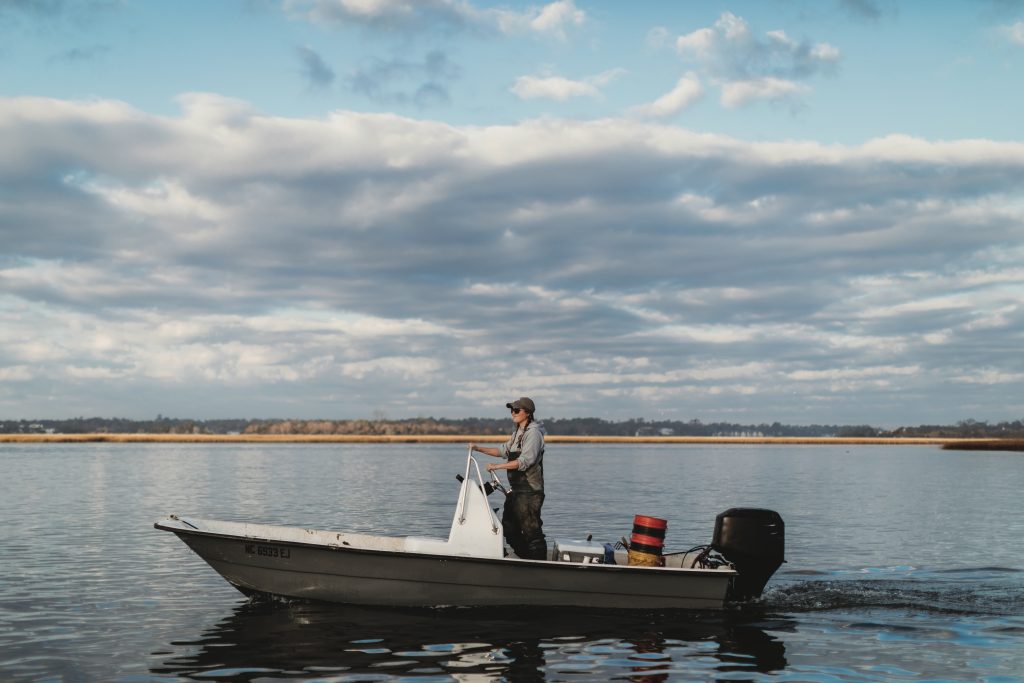
On this day, Shellem, photographer Mallory Cash and I pull our boat up to the edge of the marsh and step out, nearly losing our shoes in the squelching mud. The three-toed tracks of herons far outnumber our bootprints. Scanning the horizon, I don’t see another person anywhere.
Shellem, 35, learned to navigate these waters shortly after moving to the area 14 years ago. Raised in Tennessee and Kentucky, she started working in professional theater at the age of 8. As a teen the young actress spent summers in New York City and moved to Harlem after graduating high school. It was from there, at age 21, that she came to Wilmington for the first time.
“I hadn’t experienced the ocean like this, ever in my life,” Shellem says. “I felt drawn to it — like a need to be here.” She got a job as a bartender in Wrightsville Beach, where she met her husband, Jon, who lived aboard a sailboat at the time.
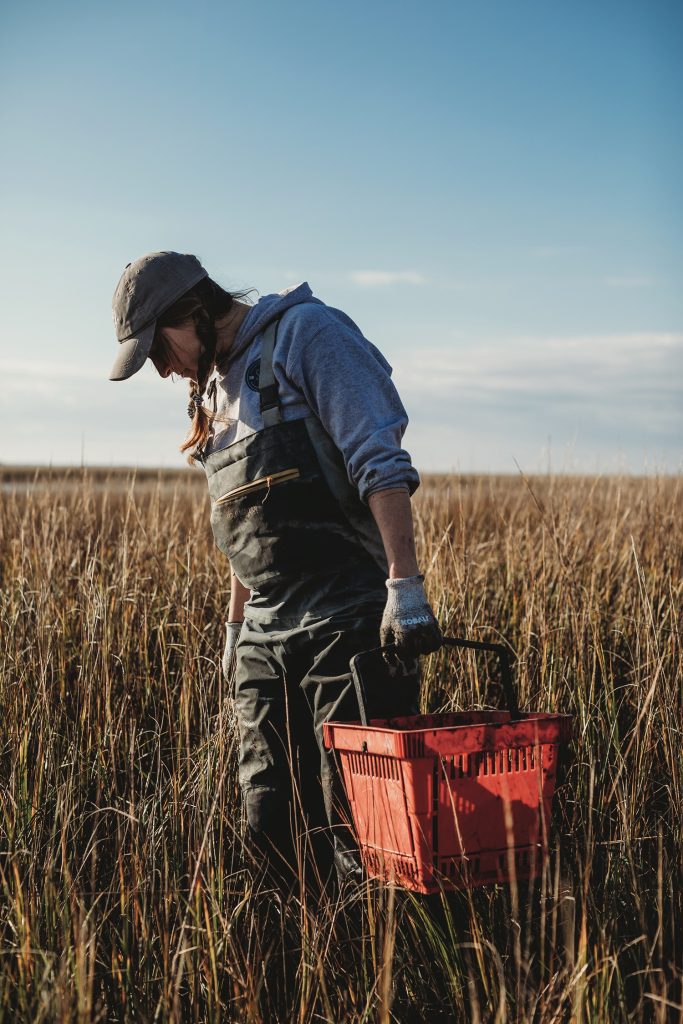
In boots, waders and braids, she forges fearlessly into the tall Spartina grass, taking in textures and subtle differences in soil color and composition to help her find what she seeks. Her mind is completely focused on the here and now. But this act of foraging is ancient, bubbling up from some part of the brain most of us don’t use anymore. In this strange postmodern age of AI and TikTok, she’s guided by the wisdom of generations of hunter-gatherers.
Today Shellem is gathering mussels, destined to become paella tonight at a local restaurant. Once called “the oysters of the poor,” many fishermen have difficulty selling these often overlooked shellfish, as the general public usually doesn’t cook them at home. Äna figured out how to get around this problem — she sells directly to chefs — and essentially made the market for them in North Carolina. Now, they’re a staple harvest for her.
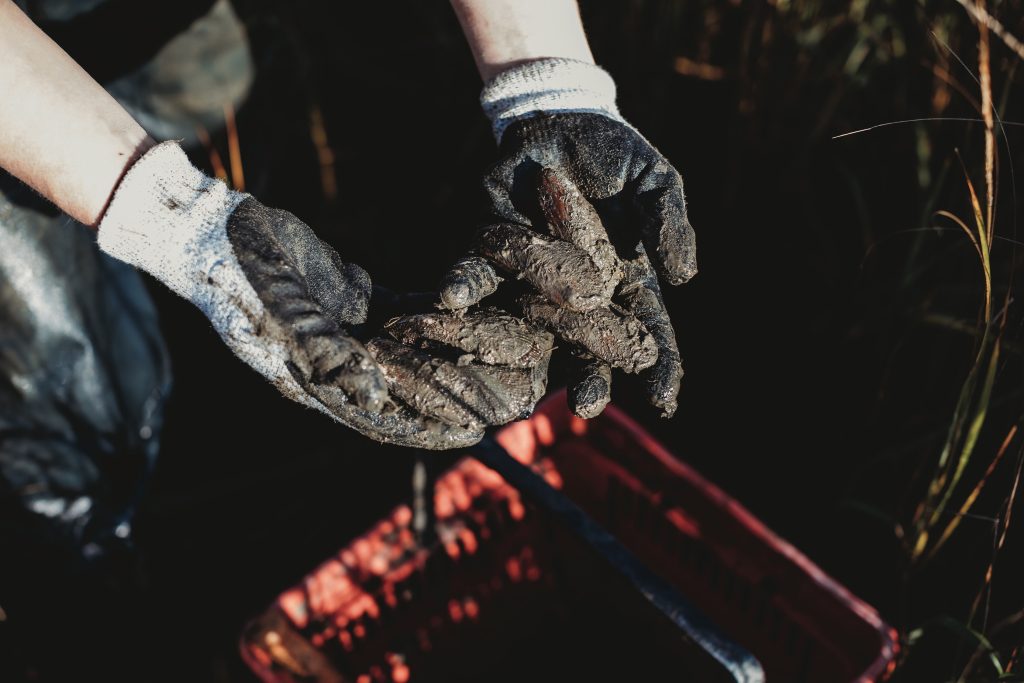
She zeros in on a cluster, nestled deep in the grass. A single well-practiced thrust with her hori-hori knife, and she rises up, a wide grin on her mud-flecked face, her gloved hand full of mussels. They are beautiful, glistening splinters of obsidian. She lays them delicately in her bucket and is off in search of more. The sun comes out and lights up the world.
On the day of our excursion, the work went easily. But there are days when the marsh hides her face, when the northeast wind blows strong, and the tide doesn’t drop. There are frosty mornings when her gloves are frozen solid and sultry evenings when no-see-ums feast on exposed flesh. There are long days with big orders to fill when her body aches from bending, from lugging heavy buckets of shellfish through the sucking mud back and forth to her trusty gray skiff. And there are duck hunters with loaded shotguns and poor eyesight.
There was the weird stillness of the COVID-19 pandemic, when her 31 restaurant customers dropped to a mere handful as they struggled to stay open themselves. Her web shrank, but the connections deepened as everyone navigated their new reality together. Some chefs continued to buy her product for new dishes that could be sold as takeaway fare. “It was a lot of casseroles,” she says later, laughing in the salon of her and Jon’s houseboat. “Shellfish aren’t a to-go food, really. But we all had each other’s backs.”
She found other sources of income — working on an oyster farm or going crabbing — but none of them called to her like wild harvest. “I’m beyond obsessed with shellfish,” she admits. She was relieved, as we all were, when the pandemic abated and normalcy slowly crept back into life.
Today, the biggest problem she faces sends its insidious tentacles stretching from one rotten source like Capt. Nemo’s killer squid: anthropogenic climate change. In the summer of 2025, the heat was insane. The air hung thick as a velvet curtain, and the blistering noon invariably conjured anvil clouds, flashing lightning teeth and roaring grumbles of thunder. Friends of Shellem’s who run another commercial fishing boat were struck by lightning that year, disabling their boat for weeks. You don’t want to be the tallest thing on the water in an electrical storm.

Summertime also brings more visitors to these fragile beaches, their cars belching carbon dioxide into the atmosphere as they search for parking spots that don’t exist. Armadas of boats with sleek lupine engines howl through the channels — another side effect of COVID was more boats on the water. Their wakes are full of beer cans and cigarette butts, slick two-stroke sheens and the dissipating sounds of Kenny Chesney. Weekends were nothing short of a bacchanal, the water festering with the detritus of partying passengers. Finfish can flee to cleaner waters offshore, but the oysters are trapped in their beds.
“It’s disgusting,” says Shellem, who stops harvesting in the summertime. “I don’t want to swim in that water, let alone eat out of it. I don’t eat shellfish that time of year, but I’m also not trying to eat a tomato sandwich in January. I always say, eat in season — it’s good for a reason. You can taste the difference.”
Oysters may remain on the menu in summer months, especially in restaurants catering to the transient tourist crowd. Shellem explains that those oysters, if local, are farmed. If they are wild-caught, they’re brought down from up North, where the water remains cold. Many restaurants buy their seafood from (and many fishermen sell their catches to) large seafood distributors. The scale and logistical complexity of these operations sometimes means an oyster has to be driven by refrigerated truck to Georgia to do time in a warehouse before ending up on a plate in Raleigh or Charlotte.
Shellem is unwilling to do this. She personally delivers each order to her clients, often within 24 hours. “The demand is there for the fishing I do. I could do more, but I choose to stay small because that’s what sustainability is to me. (Going with a big distributor) changes the way the food makes it to the plate, and I want to keep that intimacy. It means a lot to me. It’s not how I want to treat my product. It’s not how I want to treat Mother Nature. People know fresh.”
Of course, heat in the Carolina summertime is nothing new. The old saw about only eating oysters in months with “r” in them (October, December, February, etc.) is old for a reason. However, it is demonstrably getting worse. The summer heat in 2024 was the warmest since recordkeeping began in 1850 with 2025 not far behind. Shellem has noticed a difference. Her season, which traditionally runs from Oct. 15 through March 31, is getting shorter, delayed by hurricanes and rainfall in autumn and cut short by rising temperatures in the spring. Her job is being made more difficult by a slimy green algae that covers the beds, which usually doesn’t appear until late spring but showed up in February in 2025.
She’s also seen an abundance of stone crabs, a species famous on Floridian plates, that are migrating north as waters warm. Clam populations, once so abundant here that Native Americans used beads fashioned from their purple shells as currency, still haven’t recovered after the last major hurricane. In 2018 Hurricane Florence sent millions of gallons of untreated hog waste from factory farms in eastern Carolina rushing down river to the coast, where the sea turned black from the pollution. That storm almost destroyed what Shellem had worked so hard to build. She couldn’t harvest for six months afterward. We can expect more frequent and intense hurricanes as carbon dioxide levels continue to rise in the atmosphere.
“I see a lot of problems going on,” Shellem says. The one-woman nature of her business makes her problems different than bigger fishing operations, but some things are universal. “Regulation, mismanagement, politics. People not believing in science and data. And then stubbornness, of wanting to stick with what generations have done and being uncomfortable with change and afraid of change when it just has to happen, because that’s the way the world works. You have to find new ways of doing things, especially with the Earth suffering so much. She’s literally screaming at us. And if we don’t listen, we’re going to lose a lot more than we already have.”
James Brown sang that this is a man’s world, and in commercial fishing at least, that’s largely still true. But after nearly a decade in business, the other fishermen — predominately male — take Shellem seriously. They’ve learned that she’s not going anywhere. Her harvest, however, is — and fast. That speed makes a difference, according to restaurateur Sunny Gerhart, owner and chef at St. Roch in Raleigh and Olivero in Wilmington, who has been buying Shellem’s harvest since the beginning.
“The cool thing about Äna is she’s not trying to sell 10,000 bags of oysters,” Gerhart says. “She works with the folks she works with. If I say I want three bags, she’s going to harvest me three bags and that’s it. We’re getting it the same day — she’s harvesting in the morning, and then she’s on the road. It’s hard to get any fresher than that.”
With oysters so fresh, Gerhart says, it’s best to serve them raw, on the half shell, perhaps with a little mignonette. Even when he experiments with smoking and preserving the clams and mussels she brings him, echoing the culinary tradition of the Basque coast of Spain, he tries to do things simply to highlight the flavor of the product and the hard work that goes into it. “It’s a beautiful product on its own, but it’s really taken care of by Äna,” Gerhart says. “She’s a steward of the coast. We’re just trying to showcase what she’s doing, what the coast is doing. I don’t need to show off my culinary skills. She’s the one doing the hard work, so let that shine.”
Lauren Krall Ivey, co-executive chef at Olivero, echoes Gerhart’s sensibilities. “I haven’t seen anyone else wild-harvesting mussels around here,” Ivey says. “Having them is amazing and unique. They’re larger in size and different from the Canadian mussels you see around, and look great on the plate.” Ivey’s favorite presentation using Shellem’s product is an escabeche with pickled mussels and shrimp served with a Calabrian chile aioli and potato chips.
Shellem’s shellfish end up in places other than restaurants, too. Charlotte’s Free Range Brewing has brewed one of their most popular beers, Sea of Companions, with her oysters since 2018. “Äna’s oysters are the star ingredient,” says Jason Alexander, co-owner of Free Range. “They’re the saltiest we’ve ever encountered.” Combined with a malty backbone of roasted oats and wheat, 96 percent of which is sourced locally, and a touch of hops to add balance and bitterness, the result is a rich wintertime porter with notes of salted chocolate. Each 200-gallon batch includes over 600 oysters, boiled in the wort like a stew during the last stage before fermenting. “As the beer is in the kettle, we recirculate it through a separate vessel with the oysters in it,” Alexander explains. The oysters cook, releasing their liquid inside. “That breaks down the meat, adding proteins that contribute to the body of the beer, and it allows us to strip some of the minerals from the shells, which enhances the flavor.”
Art and chemistry combine to create a truly crafted brew, and it seems the city agrees: Another Free Range offering using her mussels, named Shellem’s Mussel Beach, was nominated in 2024 by independent weekly publication Queen City Nerve as Best Kölsch in the city.

Wherever her harvest ends up, it always points back to the marsh, to one hardworking woman and a dream. Despite heat and hurricanes, Shellem will be back out there tomorrow, and the next day, and the next. The pull of the moon on the tide pulls her, too. Even on days she doesn’t have orders, she often finds herself on a busman’s holiday in the marsh, exploring new spots or just pausing to appreciate the beauty around her.
“I didn’t start fishing for the money,” Shellem says. “I started because it made me happy.” Out there, in the grass and the mud, above the water and beneath the sky, it’s easy to see why.