
By Teri Saylor • Photographs by John Gessner
More than four decades have passed since Jim Wann sat face-to-face with the acclaimed author Lee Smith and performed a song he wrote, inspired by her short story “Georgia Rose.”
He vividly remembers how nervous he was.
“I had read her wonderful story and, to this day I don’t know why, but I was sitting on a sofa in New York in the early 1980s and it stuck in my head,” he recalls. “So, I just turned it into a song.”
He played it for his longtime friend and creative collaborator Bland Simpson, who suggested he play it for Smith.
“Lee came out to Bland’s house and I sat across the dining table from her, quaking in my boots,” Wann says. “I played it, afraid of looking directly at her, and at the end she loved it and told me it was just great.”
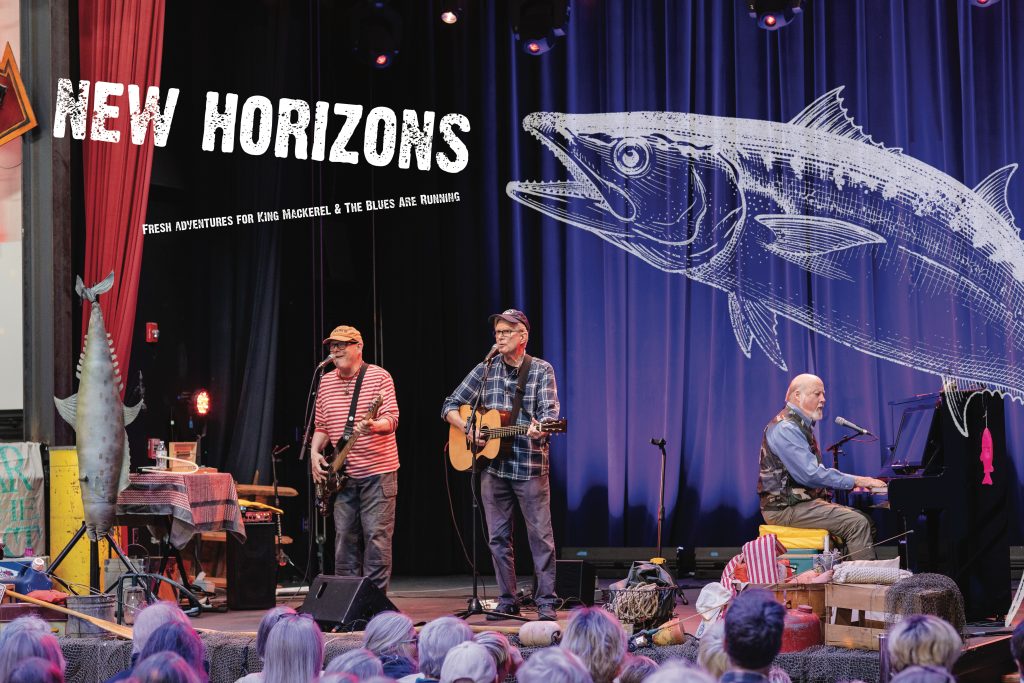
The song figures prominently in the storyline of King Mackerel & the Blues Are Running, a theater production of songs and stories about life along the North Carolina coast that’s been around for four decades. The show stars Wann, Simpson and Don Dixon as the Coastal Cohorts, a trio of fishing buddies who are staging a benefit concert to save the beloved Corncake Inlet Inn from destruction.
King Mackerel recently celebrated its 40th anniversary and Wann says singing “Georgia Rose” has been a special part of every performance. “I’m so grateful to Lee Smith,” he says. “God bless her for writing that story.”

Last November, when King Mackerel & the Blues Are Running dropped anchor on its remarkable run, the show’s creators were already looking toward the next horizon. In Mackerel years, 40 is just a state of mind.
Over two consecutive weekends last fall, the Cohorts pulled in a full house for four performances at Joslyn Hall in Morehead City and the Haw River Ballroom in Saxapahaw with energy and freshness that made the decades melt away. Now, the Coastal Cohorts are ready to cast off on new adventures and are laying the groundwork for the future of King Mackerel, too. They will always be intertwined.
“We knew that even if the performances we did in Morehead City and Saxapahaw tied a nice bow on a 40-year run of the full show, we still wanted to keep working together,” Wann says.
The trio has a repertoire of new music waiting for an audience. Most prominent is “The Edge of the Sea,” an ode to Rachel Carson, the influential marine biologist, author and environmental activist who conducted notable research on the coast, including in North Carolina, and wrote extensively about it.
“The song is a statement about Rachel Carson’s impact on the natural world, and it has become our North Star,” Wann says. And, like a merry band of pied pipers, Wann, Simpson and Dixon brought generations of audiences along with them. They deliver their powerful message with a healthy serving of nostalgia, resurrecting faded memories of slow dancing at the beach, losing love and finding it again, cruising with friends, and spending a lifetime fishing from an old wooden pier that is as familiar as home. Whether you’ve seen King Mackerel one time or 25 times, every performance feels like a warm hug from an old friend.
Wann, Simpson and Dixon began forging their bond as students at the University of North Carolina. All three went on to notable careers in music, theater and literature, but the “little fish show,” as Dixon likes to describe it, has remained a constant in their lives. When they launched King Mackerel in 1985, they were young men in their 30s. Now in their 70s, they marvel over their longevity.
“One of the most amazing aspects of the show is the generational reach it’s had,” Dixon says. “I’ve met so many people that have grown up with this show, and now their kids and even their grandkids are growing up with it too.”
Quoted in a 2005 story for the North Carolina Literary Journal by the late Jerry Leith Mills (one of the show’s early contributors), Simpson describes the plot as “loose-jointed with a minimalist story line and a lot of songs.” It’s the tale of three friends coming of age on the North Carolina coast, helping their neighbors, cleaning up after hurricanes and rising up against greedy developers.
At the heart of it is Miss Mattie Jewell’s Corncake Inlet Inn, which was damaged in a storm and is in danger of being sold to the villainous Greedhead Development Corporation, which intends to replace it with condominiums. The three protagonists plan to stage a fundraising concert to help save the inn.
“The Greedheads had crept into our consciousness back in the 1980s when we were aware of the pressure to develop the coast, and we felt that deserved some pushback,” Simpson says. “Our simple idea was that we didn’t want Miss Mattie’s beautiful old Corncake Inlet Inn to be replaced with a high-rise, and that’s really what drove the storyline.”

The trio reckoned that any song about nature’s beauty, by definition, was a statement against development, and from there the creative process was linear.
“We were trying to figure out a beginning, a middle and an end, and we knew that a hurricane would be at the end,” Wann says. “Once we had the Greedheads, they became irresistible, so we sprinkled them throughout the show and wove them into our theme.”
The story closes as the hurricane uproots a new condo cluster that the Greedheads have built and sends it floating out to sea. “The coast emerges as the hero,” Wann says, “and that’s the little slender thread of the plot of King Mackerel & the Blues Are Running.”
Originally, King Mackerel was conceived with beach music in mind. Wann and Simpson had set out to write a show for The Embers, recognized as the pre-eminent beach music band in the Southeast. “We were somewhat cautious about it because they were an unknown element as far as theater went, and we pondered if we were to write a show for The Embers, what would it be?” Simpson says.
They came up with scratchy old records, cars stuck in the sand, pier fishing, shag dancing and falling in love on the beach. In the end, The Embers, who toured and performed six days a week, could not come off the road long enough to stage a show and passed on the project.
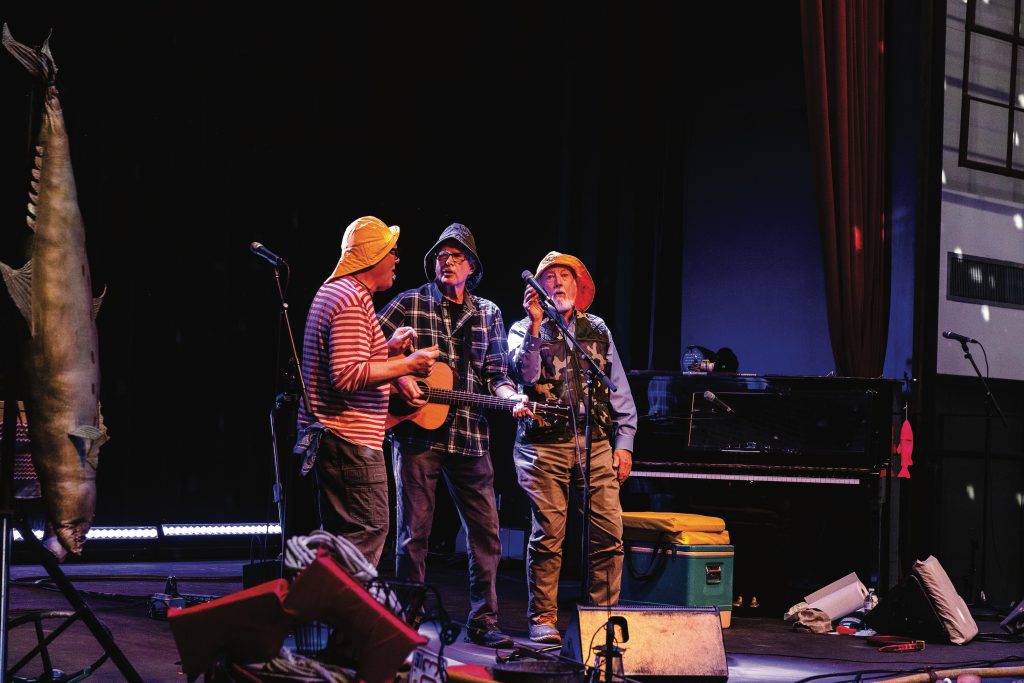
Wann and Simpson, who were having the time of their lives composing the music, had half a script finished, so they decided to forge ahead without The Embers. “We fashioned the Coastal Cohorts, a trio of folk singers that play in an old hotel lounge, and not only sing songs about the coast, but tell stories and give people a great feel for that area,” Wann says. “And we reasoned that we could be those guys.”
They needed a third Cohort to round out the group, and Simpson says it took about 30 seconds to determine Dixon was perfect for the role. But Dixon, who was gaining success as a musician, singer-songwriter and producer, had scant theater experience and couldn’t see how he would fit in.
“We told him his job was to steal the show,” Wann says.
Dixon didn’t need much arm-twisting. “I just trusted them and decided to give it a shot,” he says.
On December 8, 1985, King Mackerel & the Blues Are Running opened at Rhythm Alley in Chapel Hill for a weeklong run and returned the following spring for a longer engagement. The Coastal Cohorts started building a following and never looked back.
Simpson, who was born in Elizabeth City and grew up in Chapel Hill, is an award-winning author and for years has played piano with the famous string band the Red Clay Ramblers. He’s written dozens of books, plays, stories and essays and holds the title of Kenan Distinguished Professor of English and Creative Writing Emeritus at UNC. He was inducted into the North Carolina Literary Hall of Fame in 2020.
In 1975 he co-authored and performed in an award-winning off-Broadway musical production with Wann called Diamond Studs: The Life of Jesse James.
Wann, who grew up in Chattanooga, Tennessee, helped launch the Cat’s Cradle in Chapel Hill, which has nurtured many bands since the 1970s and is still going strong. He is a Tony-nominated Broadway composer, lyricist and performer, known for the hit musical Pump Boys and Dinettes, blending Southern roots music with colorful storytelling and defining the actor-musician theater genre.
Dixon, who hails from Lancaster, South Carolina, launched his musical career on stages in Raleigh and Chapel Hill, including the Cat’s Cradle. During a career spanning decades, he co-founded Arrogance, a popular and influential band that played all over the eastern part of the country in the 1970s, recording six albums. He has produced albums for R.E.M., and worked with numerous bands including The Smithereens, while also crafting his own solo material along the way.
On the rehearsal day for the 40th anniversary shows in Morehead City, Dixon drove in from his home in Canton, Ohio. Wann made his way from Tybee Island, Georgia, and Simpson arrived from Chapel Hill. They began unloading their vehicles, and in clown-car fashion, pulled out a seemingly endless stream of equipment, instruments and stage props that Simpson stores in a shed at his home.
Out came guitars, amplifiers, coolers, fishing nets, old suitcases, gasoline cans, crab pots, life jackets, tackle boxes, boat cushions and the large stuffed toy mackerel that makes its appearance at the top of the show when Wann flops it over his shoulder and casually carries it on stage.
In 1986, King Mackerel was barely off the ground when Todd Miller, founder of the North Carolina Coastal Federation, offered to sponsor shows in Carteret County and beyond. (The Morehead City show was co-produced with the Coastal Federation and the Core Sound Waterfowl and Heritage Center. The show in Saxapahaw was presented by the North Carolina Land Conservancy.)
“I thought we would be a perfect fit with King Mackerel & the Blues Are Running because one of the keys to our work is encouraging people to love the coast, celebrate it and protect it,” Miller says. “The show does such a good job of cherishing all the good things we have here.”
Wann, Simpson and Dixon thought it was a great idea. “We reasoned that with Todd’s support, we would get to play and have an audience, and they might get some new memberships out of it,” Simpson says.
To Miller the show remains relevant. “The world keeps evolving but the stories endure. The natural areas of the coast will continue to adjust and are more likely to survive than the human development that is trying to reside on it,” he says.
On a warm autumn morning as sailboats drifted along Taylor’s Creek in Beaufort, a flock of black skimmers took to the sky, breaking the silence with their noisy chatter and flapping wings. They swooped and rose, then huddled together in a dense pack on the beach at Bird Shoal on the Rachel Carson Reserve.
The reserve is made up of five small islands encompassing about 2,300 acres of estuarine habitat that is home to over 550 documented species of living creatures, including over 200 species of birds, says Ben Wunderly, central sites manager for the N.C. Department of Environmental Quality’s division of coastal management.
The salt marshes, tidal flats, dunes and maritime forests on the Rachel Carson Reserve protect Beaufort from storms and are a habitat for wildlife, including herds of feral horses that have lived there for as long as anyone can remember. In 1977, Beaufort residents, civic organizations and environmental groups worked together to prevent the development of a resort on the islands. It took over a decade, but by 1989 the state had designated the land as a dedicated nature preserve.
Wunderly says art, music and literature go hand-in-hand with nature and are a force for good. “Promoting stewardship of the natural environment through the arts benefits everyone in the long run,” he says.
Wann, Simpson and Dixon together drew inspiration for “The Edge of the Sea,” their musical tribute to Rachel Carson, from the reserve that bears her name and from her book with the same title. It was a work in progress for 15 years and recorded in a studio last summer. The song, clocking in at eight minutes, 29 seconds, features women’s voices, marking a first for the Coastal Cohorts.
It was Dixon’s idea to include a lilting introduction to set up the main body of the song and suggested referencing Carson’s own words: “The edge of the sea is a strange and beautiful place.” A choir of dreamy voices features Dixon’s wife, Marti Jones; Rebecca Newton, of Rebecca & the Hi-Tones; Durham educator Pattie Le Sueur; and Simpson’s songwriting students at Carolina, Madeline Lai and Maggie Thornton. The Cohorts provide the lead vocals, with Dixon on bass and guitar, Simpson on piano and Wann on guitar.
“The song is a rousing call to action, and represents a new path for us,” Wann says, adding that they are at work charting that path, focused on a project reflecting Rachel Carson’s life and legacy.
“We’ll add other related material in a way that catches people’s eyes and ears, and we hope their hearts and minds,” Simpson adds. “That’s daunting and challenging, and it’s fun to think about.”
At the heart of their future work, the environment will remain a constant. “We certainly want to maintain our relationships with the environmental world and the ongoing need to address its challenges,” Dixon says. “Those themes have evolved into something that matters.”
Karen Willis Amspacher, executive director of the Core Sound Waterfowl and Heritage Center and a longtime supporter, appreciates that sentiment. Her family has been a part of Harkers Island for generations. She says the Coastal Cohorts began singing about Down East communities when they needed it the most. “Being in their presence for even two minutes here and three minutes there you can feel their kindness and their stewardship,” she says, wistful about the changes Father Time has inflicted on her beloved coast and the way of life there.
If the Cohorts are following new pathways, they expect King Mackerel & the Blues Are Running to do the same. The show has taken on a life of its own. The script and license agreement are available for both amateur and professional performances from Concord Theatricals, and actors of all ages have performed it on stages across the United States and in Canada.
“It’s exciting that other actors have performed it,” Dixon says. “In the script, we encourage people to use their own names and insert references to local places so their audiences can identify with it.” The show has played in Indianapolis, Virginia Beach, Cape May and Martha’s Vineyard, among other places.
The Cohorts themselves have performed both long form and concert versions of the show all over the country, including in New York City’s Laurie Beechman Theatre in the West Bank Café and at the Kennedy Center. In 1995 they recorded it in front of a live audience for PBS, and it’s still available online.
Simpson’s favorite performance hit close to home when his daughter Susannah’s fourth grade class at Seawell Elementary School in Chapel Hill staged an abbreviated version in the mid-1990s. At the time, the show gave Miss Mattie a speaking part, and Susannah claimed that role for herself.
“The little fellow who was asked to sing the song ‘Shag Baby’ got the jitters about 10 minutes before showtime, and I gave him a pep talk,” Simpson recalls. “He was holding a pair of sunglasses, and I told him if he would put those sunglasses on when the curtain opened, people would cheer and clap, and it was true, the audience went wild.”
Wann, Simpson and Dixon plan to devote part of the new year to recording the 40th anniversary version of the show, merging the songs and dialogue into a seamless track. Then they will score it, script it and pass it along to Concord Theatricals to join the original version.
And while the most recent shows may mark the final full performances of King Mackerel, the three friends promise their fans that they haven’t seen the last of the Coastal Cohorts. They look forward to showcasing their new music, although Wann likes to joke that future performances might involve sitting in chairs.
“The Lord wants us busy, that’s for sure,” Simpson says.