
By Kristi Southern
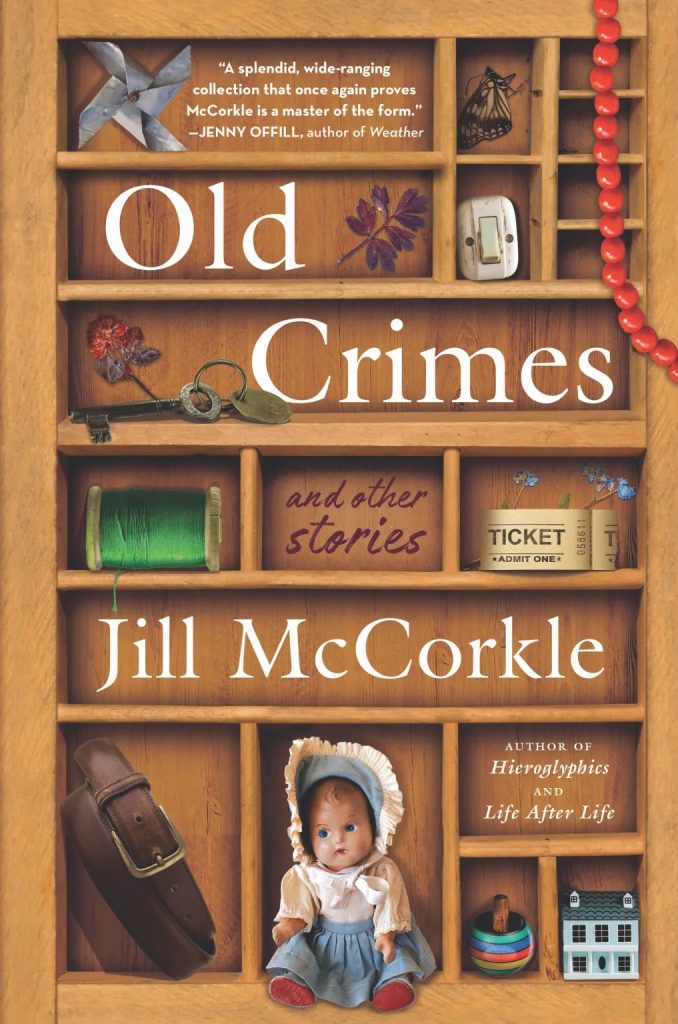
Jill McCorkle’s 2024 Old Crimes and Other Stories is a collection of 12 narratives that include interconnected elements and contemplative characters who seem to be searching for, or reflecting on, their place in life. McCorkle’s characters are unique and most are likeable, but her stories are a bit bittersweet. Many of her players scrutinize missed chances in their lives, wish for something more, or are still waiting for their time to come. Their quirkiness keeps the stories from being overly sad, but there is still a tinge of regret that warns readers to grab chances and recognize life and its opportunities as it is happening.
In the title story, “Old Crimes,” readers meet narrator Lynn, who is looking back on a trip with a boyfriend whose name she doesn’t remember. Lynn and the boyfriend, Cal, were young college students on a weekend getaway that doesn’t quite hit the expected mark. The inn where they are staying is dated and cluttered with nostalgic Americana knickknacks, and Lynn comes across as lonely while on what was supposed to be a romantic getaway. Young Lynn is told by her guidance counselor that she has choices in life, can go anywhere, that it isn’t “about right or wrong, but what’s right for (her).” By the narrative’s end, though, readers see future Lynn, facing a new start, but perhaps it isn’t as optimistic as a new start could be.
In “Low Tones” we meet Loris Ward, whose husband, Alton, is no longer himself, living out his remaining days in the local hospital. To Loris, Alton is not the upstanding person their community has perceived him to be throughout their marriage. Loris was not prepared for Alton’s health turn, but as we learn how Alton has treated her over the years, there is not much reason for her to be mourning. She has slowly been losing her hearing, particularly those lower tones of her husband’s voice, and we get the impression that “the calm comfort of absolute silence” has been somewhat welcome. Perhaps it is ironic that Loris can no longer hear her husband’s voice, as he doesn’t appear to have listened to her needs for most of their marriage. We encounter these two characters later in “Filling Station,” connecting narrator Ben with them both, seeing them from the perspective of someone who knows the community’s view of Alton but not necessarily Loris’ inside view.
Marnie and Roland, who also appear in “Filling Station,” are introduced in “Swingers,” but the story starts after Roland’s death as Marnie wonders how much longer she will be able to stay in his home. Although they were in love and together for some time, Roland never got around to divorcing his wife, and Marnie questions what her place in his life was. “Where do I fit in?” she has asked him more than once, but a clear answer was never received. She knows she is loved by Roland, but she wants to know when her turn will come. Roland’s heart gives out before she gets her chance; “like so many things in life, she didn’t get the chance and now she has to just let it go.”
“A Simple Question” finds Anna looking back on her friendship with Muriel, an older friend from years before, and recalling the day Muriel started to ask something but then decided to wait. The question was never asked, reminiscent of how chances are missed throughout this collection. Anna and Muriel are at almost opposite stages in their lives during their friendship: Muriel is married with a son with a life that is “fixed and decided” (albeit she also shares with Anna her sadness and regrets); while Anna is eagerly waiting for her life to begin, “her real life.” One friend is hopeful and anxious for life to get started, as the other is hoping to hold on to the one she has — and hoping for a friend who will listen.
Another struggling, unheard mother is introduced in “The Last Station,” although we never learn her name — she is simply “Tori’s mother.” The lack of a name given to this character emphasizes her place in the family as a mother who has sacrificed, gifted, nurtured and cared for her family with little of these things, if any, in return. Every spring, Tori’s mother holds a performance in the front yard, carrying a cross over her back like Jesus, shouting out injustices with both drama and humor. This year’s show escalates as Tori’s mother reflects on the wrongs that have befallen her — receiving a lamp after serving 35 years as an elementary school librarian; her family not remembering her birthday; giving up broccoli and cats due to her late husband’s dislikes; and just feeling “invisible and unloved.” A devoted mother and wife for years, Tori’s mother wants to know “why didn’t I get to want something,” and she cries to those watching: “I want more. I want my turn.”
“Act III” introduces readers to a similar mother who also knows that “it all goes too fast.” Vera, a retired high school drama teacher, and her husband, Glen, are on a mountain getaway with their grown children and grandchildren, enjoying time together reminiscing about the past. With small hints throughout, we learn that Vera is sick, but she has not yet shared this with her family. She clearly loves her family but has no trouble recognizing their tiresome eccentricities, their faults and their annoyances. She is honest and relatable and seems to represent a number of mothers who have dutifully raised families while working a full-time job, remaining open-minded, and seeing the humor in daily life. She compares life to the theater, acknowledging that she is now in Act III and is the one character who seems to be somewhat satisfied with the life she has lived.
McCorkle’s collection of these memorable characters leaves the reader with a desire to be more aware and open to the opportunities life presents. The alternative is the regret born of never sensing that it was your time when your time presented itself — that life did take off, with or without you.