By Liza Roberts • Portraits by John Gessner
When the artist Karina McMillan was growing up in rural Robeson County, she spent long days outside in the woods and in the surrounding fields of cotton, soybean and tobacco near her house, and long hours with her family, steeped in the culture of the Lumbee Tribe of North Carolina. Never far from her side were the ballpoint pens and paper she used to draw all of it, and all of them.
“One of my first memories is my dad telling me, ‘If you don’t know how to spell something, draw a picture,’” McMillan, now 27, recalls. “I didn’t really know how to spell a lot of things, so I would just draw.”
One day in kindergarten at Hawk Eye Elementary, she drew a picture of the school’s mascot. She was surprised that her teachers made such a fuss over her hawk, hanging it in the school’s lobby, even turning it into a postage stamp for the campus mail system.
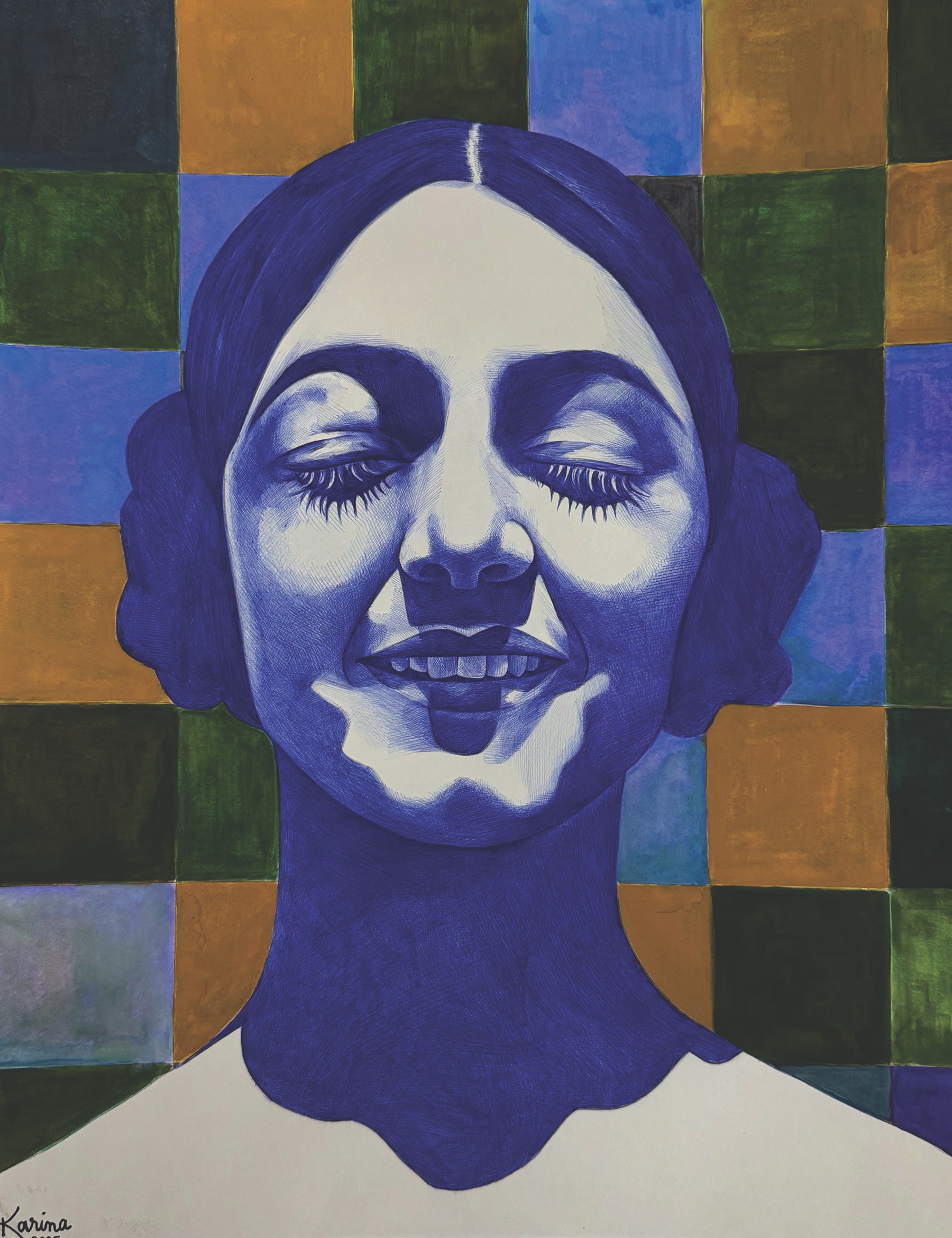
More than 20 years later, McMillan’s hawk is still hanging in the school’s lobby, and a standard-issue blue Bic ballpoint pen is still her favorite way to draw. Her subtle, shadowed, soulful portraits of Lumbee and other Native people and their landscapes may look painted from even a short distance, but up very close, the fine detail of McMillan’s hashed and feathered pen strokes becomes clear, emerging from an image as the grooves of a fine-grained woodcut do. In some of her works, she uses acrylic paint in bright hues for backgrounds, clothing and textile patterns, and to create glowing haloes for her subjects.
“Karina McMillan’s work is extraordinary,” says Sara Segerlin, director of the Gregg Museum of Art & Design at N.C. State University. “Her paintings carry a power that goes far beyond color or technique. She brings forward portraits of resilience, memory, pain and strength, stories that refuse to be forgotten.”
McMillan’s work has been exhibited and won awards and recognition all over the state and beyond, and is primed to find a larger audience, says Nancy Strickland Chavis, director and curator at the Museum of the Southeast American Indian at the University of North Carolina at Pembroke. Indeed, Chavis says, an artist like McMillan emerges from her region just once in a generation.
“She will define what this era of native art is for native artists,” Chavis says. “I think that she will lead the way for her age group, moving forward along with other greats like Jessica Clark (Lumbee, in her 40s), and Gene Locklear (Lumbee, in his 70s), to really push the envelope on what the possibilities are.”

McMillan’s Mother Nature, a portrait of a Lumbee woman holding ears of corn rendered in ballpoint pen and acrylic paint, exemplifies the young woman’s technical virtuosity and her ability to depict her people authentically, Chavis says, without the “tropes” deployed by some artists painting Native Americans. She notes that the woman McMillan depicts in Mother Nature is immediately recognizable as Lumbee, and the corn she holds represents the corn reclamation program currently underway to return ancestral strains of corn to the Lumbee people.
Chavis says the portrait is characterized by humility and gentleness, and resonates deeply with audiences who see true reflections of themselves within it. “When I saw it, I lost it,” says Chavis, who is also a member of the Lumbee Tribe. “We don’t have a lot of artists that are doing the type of work that Karina is doing.”
Chavis awarded the piece best in show at her museum’s annual 9/9 Native South Juried Exhibition last September and purchased it for the museum’s permanent collection.
Corn, pine cones, birds and animals native to Robeson County are among the images that appear in McMillan’s work, as are other symbols and patterns that represent her heritage as a member of the Lumbee Tribe.
Learning about her forebears and their traditions as a child made a big impact on her, McMillan says, and remains central to her identity as a young adult. Currently working as a preschool art teacher at Cary’s Ivybrook Academy, she wears a Lumbee pine cone ring on her hand and spends every evening creating works that celebrate her culture.
“I like making art about it to show people that we’re still here,” she says. “We’re still Native. We’re not riding horses and living in tepees, but we’re still here.”
It’s a timely message. Last December, the Lumbee Tribe, which has been recognized by the state of North Carolina since 1885, was finally granted full federal recognition. With a population of more than 56,000 in North Carolina, many of whom live in Robeson County, the Tribe is the largest in the state and the largest east of the Mississippi River. “The history of the Lumbee Tribe long predates the history of the state of North Carolina itself,” Governor Josh Stein noted in celebrating its federal recognition.
“The fight’s been going on since the 1800s,” McMillan says. “So I feel like now we’re finally getting what we’ve deserved for the longest time. It makes me sad and breaks my heart that some people aren’t around to see that we’re federally recognized. Like my great-grandma, my great-grandpa, they’re gone . . . but at least I get to see it. This is a big moment in history, and I’m just really blessed that I get to see it happen.”
McMillan returned to Robeson County to complete her education at UNC Pembroke after two years in college at UNC Charlotte, and to be closer to her family. It was at UNCP, she says, that her artistic voice truly began to take shape.
It’s also where she decided to embrace the humble tool that got her started and has now become her hallmark: the ballpoint pen. It’s what was plentiful and close at hand growing up, when the nearest art store was an hour away. “I thought, ‘How am I going to get these art supplies?’ I just figured, I guess, I’ll draw with what I have. So that’s why I stick to the cheap mediums like ballpoint pen,” she says.
To know it is apparently to love it. McMillan says the medium is both more exacting and more malleable than you might imagine. “If you make one mistake with a ballpoint pen, you can’t go back and fix it. So I’m super focused,” she says. “And it creates the most beautiful — to me — the most beautiful values in a portrait. It can go from light to dark. You just have to keep building up the color. There have been times where I’m working on a piece, and I have to step away from it because the ink is wet. To create more layers and more values, I have to come back later, maybe like an hour later, because it has to dry before I can build up more.”
McMillan’s use of a medium that’s easy to come by puts her squarely in the Native artist tradition. “It reminds me of a lot of Native art, made out of what is accessible, from traditional to what has evolved as modern work,” says Chavis. “Whether it’s grass, pine needles, split oak, clay, all of these things that make our traditional art are what’s accessible.”
Native American artists with connections to North Carolina, including McMillan, are the focus of the exhibit “Stories Told by Breath: Native American Voices in North Carolina,” opening March 26 at N.C. State’s Gregg Museum of Art.
McMillan’s work — she will have 11 pieces on show — will be in good company. Other artists include Senora Lynch (Haliwa-Saponi), Harlen Chavis (Lumbee), Aaron Baumgardner (Catawba), Coda Cavalier-Keck (Occaneechi Band of the Saponi Nation), Amy PostOak (Eastern Band of Cherokee Indians) and Johnny PostOak (Muscogee Creek) of Three Sisters Designs, Rhiannon “Skye” Tafoya (Eastern Band of Cherokee and Santa Clara Pueblo), Joshua Adams (Eastern Band of Cherokee), Idalis Dial (Coharie), Tim Locklear (Lumbee), N.C. State students Ashytn Thomas (Lumbee) and Victoria Wilson (Haliwa-Saponi), and Gwen Locklear (Lumbee).
McMillan says she’s excited for the opportunity to see her work at the Gregg among other Native American artists, and to participate in an artists’ panel talk there on April 18. Segerlin, the museum’s director, says McMillan’s work should make an impact. “I hope more people will come to know Karina through her work and spend time with her iconic paintings. They stay with you long after you leave,” she says.
McMillan’s hoping for the same. “I want to be in more museums,” she says. “I’ve had art in different shows in different states, but I want my art to be all over the country, maybe even overseas. I just want more people to see it so they can see who Lumbees are, and what we are as people.”
Chavis says the young artist has every reason to believe in herself. “The sky’s the limit for Karina. Her work is so good. I think that the art world might take her to places she never imagined.”