By Jim Moriarty
Photographs by Jaclyn Morgan
When I pulled into the driveway of Sarah and Curtis Strange’s home in Morehead City, the two-time U.S. Open champion was hunched over in the front yard, removing an offending weed from his carefully sodded lawn. It looked for all the world like he was manicuring his grass with a pair of cuticle scissors. But you don’t win our national Open — for my money the most demanding test in golf — in back-to-back summers without being the kind of person who tends to the little details.
I’ve known Curtis Strange for going on 52 years, known him in the way sportswriters know the athletes they cover. And, to be honest, I’m fond of him. If he could be salty and hard-edged on the golf course (and he could), he could be quick-witted and thoughtful off it, though he would recoil in horror at the notion of being called charming. Strange is high on my list of people I enjoy having a cold beer with.
I first saw him play when he won the prestigious Western Amateur Championship, beating his dear friend and Wake Forest University teammate, Jay Haas, in the finals. He was 19 years old, a power hitter coming off a freshman year highlighted by a 1-iron to 12 feet to make eagle on the final hole on his way to winning the NCAA individual title and leading the Demon Deacons to the team championship. It was a crown they would successfully defend the following year, a harbinger of back-to-back success to come.
After an opening round of 80, Strange still nearly won the 1985 Masters but for water balls on the 13th and 15th holes on Sunday, shots he was mercilessly second-guessed for by the press. I can still picture him straddling the creek in front of 13 green, staring down at his golf ball, hoping it was playable. And I was right behind him when he got up and down from a greenside bunker on the 72nd hole of the U.S. Open at The Country Club and then beat Nick Faldo in an 18 hole playoff the next day, 71 to 75, with 11 one-putt greens. That was the day Strange accepted the trophy, saying “This is for my dad, and that’s all I can say. I’ve been waiting a long time for this.” The U.S. Open typically concludes on Father’s Day and Strange’s father, Tom, who played in seven U.S. Opens himself, passed away 19 Junes earlier from lung cancer at the age of 38. He doesn’t talk about it, but Strange wouldn’t allow himself to be inducted into the Virginia Sports Hall of Fame until his dad, who won the Virginia State Open five times, was.
I was on the 18th green at Oak Hill Country Club when Strange became the first player to win back-to-back U.S. Opens since Ben Hogan did it in 1950-51. Fist-pumping his way up the steep grade to the 18th green in 1989, he later said, “Move over, Ben,” to the media, giving the press another chance to have a go at him. I was at that same green when he was nearly inconsolable after losing a decisive singles match to Faldo in the ’95 Ryder Cup, two stars past their prime spewing oil on the way to the house and a European victory. And I was there when he captained the Americans at The Belfry in England seven years later after 9/11 forced the postponement of the Ryder Cup matches the previous year.
If Strange is not the greatest player I ever covered — after all, Jack Nicklaus and Tiger Woods were hanging around, too — he might have been the toughest. He was stubborn and determined. He could run hot. Sometimes the hotter he ran, the better he played. He ran hot enough to be considered the best American player in the world in the 1980s, a decade dominated by Europeans like Faldo, Seve Ballesteros and Bernhard Langer. When Strange was inducted into the World Golf Hall of Fame in 2007, he said, “I’m the first one to admit, you’re not going to confuse my record with the other ones that are in this Hall of Fame. I know that,” he said, invoking the Nicklauses and Hogans and such. “But I’m under the same roof and that’s good enough for me.” And no one ever worked harder to get there.
At the HOF induction, Strange was introduced by his twin brother, Allan, a highly successful financial adviser, who recalled their father speaking to them when they were 12 or 13 riding home from Bow Creek Golf Course in Virginia Beach, where Dad was the head pro. He asked his sons if they had any idea what they wanted to be when they grew up. The twins said, “No, sir.”
“That’s OK because I want you to make me a promise,” Tom Strange said. “I want you to promise whatever you do in life, you’ll strive to be the best. And you’ll do it every day.” They didn’t let him down.
At Medinah CC outside Chicago in 1990, when Strange was trying to win three U.S. Opens in a row, he knew he didn’t have his best stuff but still managed to find it within himself to claw his way into contention with a 68 on Saturday, leaving him two off the lead. He shot 75 on Sunday, six shots behind Hale Irwin and Mike Donald. (Irwin would win his third U.S. Open in a playoff the next day.) For whatever reason, Strange didn’t play very well after Medinah. He had two more top 10s in the Masters and another top five in a U.S. Open and struggled with back issues, but the truth was, some of the air had gone out of the balloon. By 1997, 18 years after winning his first tournament on the PGA Tour, he was in a television booth sitting next to Mike Tirico and happy to be there.
If a tournament golfer is an island, live sports broadcasts are the ultimate team game. “The TV thing has been terrific, and I’ve enjoyed every part of it,” says Strange, who now sees limited on-air duty at the Masters and PGA Championship with ESPN. He remains close with a lot of the personalities he shared airtime with, including Tirico. “They’re brilliant, all of them,” he says ticking off names like Jim McKay, Jack Whitiker, Bob Rosburg, Judy Rankin, Terry Gannon, Dick Enberg, even a few quick hits with Brent Musburger, Jim Nantz and Vin Scully. He admired all of them and became close friends with most of them.
“It’s been a lot of fun to learn from them and get to know them. They have to be brilliant. They’re sponges. They just remember everything. Mike (Tirico) still writes all his own stuff. Every golf tournament he went to he had a book. A couple of years ago he was talking to somebody at Augusta who was getting ready to start calling some football. Mike says, ‘I know it takes time, but do all your research yourself and put it in the book because you’ll remember all of it. Don’t let some other guy do it.’ He’s right. It’s like schoolwork.” Strange studied harder at ABC than he ever did at Wake Forest — of course, the exams were different.
The single tensest moment of Strange’s broadcast career was undoubtedly calling the collapse of Jean van de Velde in the 1999 Open Championship at the Carnoustie Golf Links. It was a 72nd hole meltdown so dramatic it has become the collapse against which all others in the sport are measured.
“I still feel for him, honestly,” says Strange. “One of the hardest things I had to do was call it. Tirico told me early on, at the Open Championship, he says, on the weekend, just be ready. Be ready for that moment. It’s all BS until the shit hits the fan, till it gets down to crunch time. Van de Velde was the time.”
Van de Velde’s club choices have been criticized and analyzed ad nauseum. Driver off the tee. (First mistake.) But it misses the Barry Burn. Then a 2-iron. (Second mistake.) He could have laid up, taken the easy bogey and gone home with the claret jug. Instead, his shot caromed off the grandstands, bounced off the top of the burn and into tall, hosel-snatching grass. He dumped his third into the burn, contemplated playing it from the water, then chose otherwise. That’s when Strange summarized the entire escapade as “one of the most stupid things I’ve ever seen in my life.” He didn’t, as he some suggested at the time, call Van de Velde stupid. The criticism was of the Frenchman’s course management, not his IQ. Van de Velde had been enveloped by the brain fog of pressure. He no longer knew where he was.
A dozen or so years later, Tirico and Strange sat down together in Tucson to roll back the tape. “We went for 45 minutes on the last two holes,” says Strange. “It was emotional for both of us.”
If Van de Velde was the pinnacle of melodrama, being on the ground to report on Brooks Koepka joining the back-to-back U.S. Open club in 2018 at Shinnecock Hills Golf Club (the site of this year’s U.S. Open) was satisfying in an entirely different way. Strange, 29 years removed from doing it himself, gave Koepka a quick embrace as he was coming off the 18th green. “Hell of a job, bud,” he told him, smiling broadly. Strange characterized that day as “one of the thrills of my life.” For his part, Koepka hadn’t processed what winning back-to-back U.S. Opens — doing something that so many of the game’s immortals couldn’t — would mean. “That special feeling comes 30 years down the road,” says Strange.
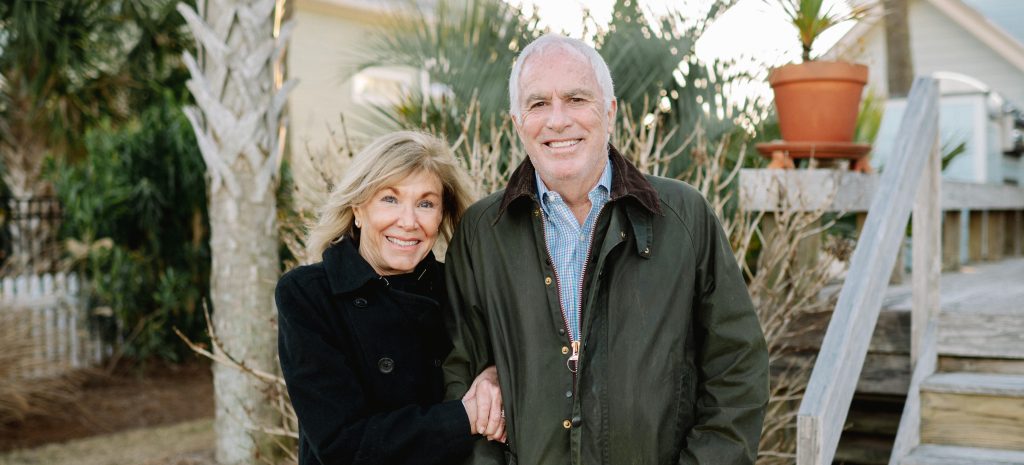
Blessed with success, Curtis and Sarah Strange can afford to live anywhere they want, and for the last 21 years that’s been Morehead City, scattering in a few months every winter on the Gulf Coast of Florida. Sarah grew up roughly 40 miles from Morehead in New Bern. As a kid she dressed in period costume, a prop for the tours of Tryon Palace, where her mother was a volunteer hostess. Sarah and Curtis met at Wake Forest, and after his junior year, their golf odyssey began — two kids, 21 and 20, off to Japan, Bali, Australia, then the PGA Tour, broke most of the time.
“We could only afford hotels under $20 a night,” Strange said at his HOF induction. “One really nice hotel we stayed in, I won’t tell you the town, had an hourly rate. One morning the maid asked Sarah if her mother knew where she was.” Next year they’ll celebrate 50 years of marriage.
They settled in Williamsburg, where they raised their two sons, Tom and David. Of course, there were trips to New Bern to see family, and that led to beach houses at Atlantic Beach for a couple of weeks every summer. After 28 years in Williamsburg, and as Sarah’s parents aged, the move to Morehead City made all the sense in the world.
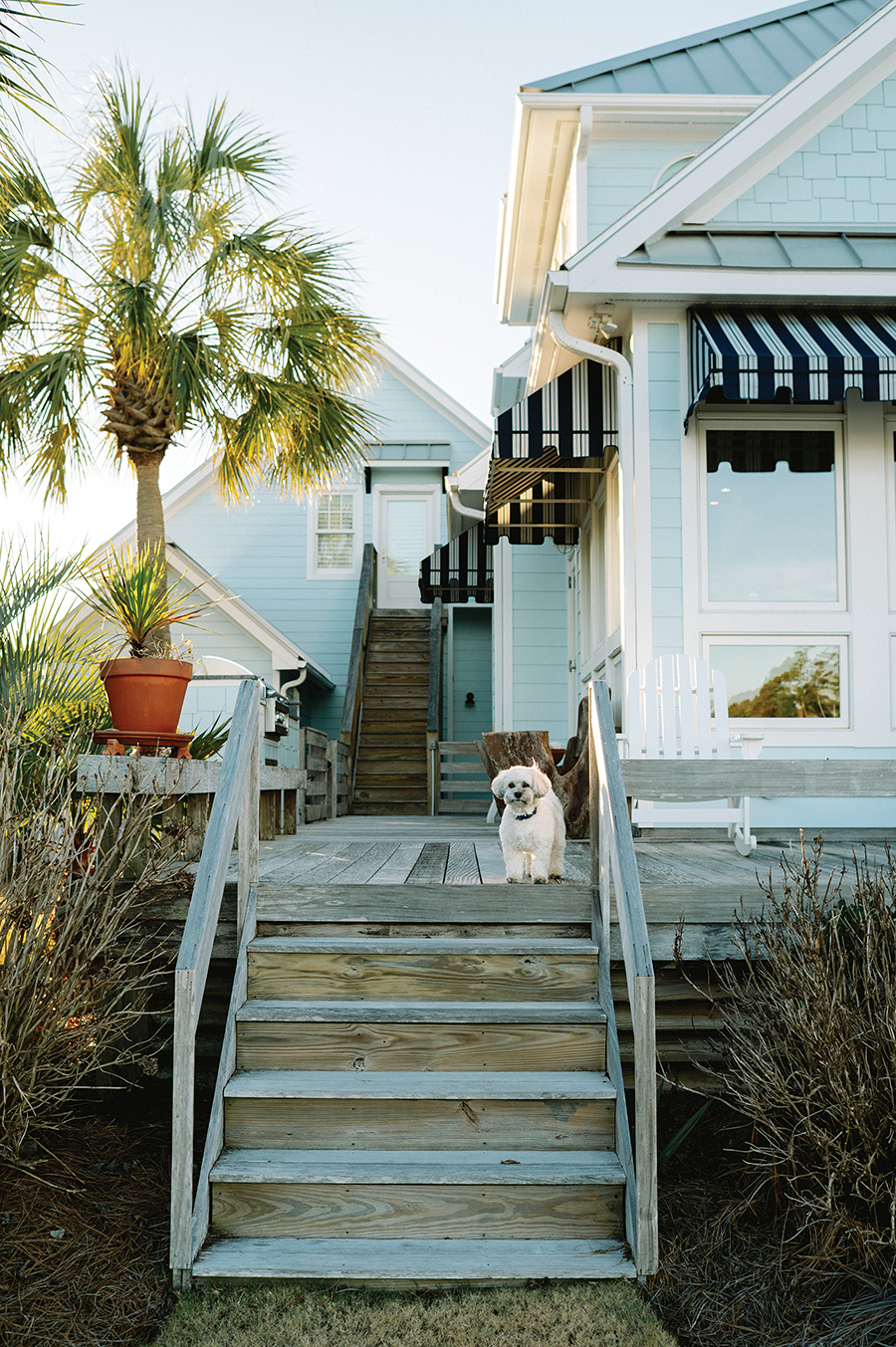
“It’s great down here,” says Strange. “Beautiful beaches. Great restaurants. Nice people. Morehead City Country Club is a great little golf course, beautiful practice facility. We’ve always liked small towns — Williamsburg was small in the day.” When they began looking for houses, they searched inland, off the beach, and found a piece of property, a hurricane hole, that was still on the water — Strange could park his boat in the backyard — but protected from storm surges. “The highest it ever got was 10 feet in the grass. It never reached the house.”
After Hurricane Florence hit in 2018, Strange launched his own emergency response. “You want to help because you have power, you have a house, a roof above your head and so many don’t,” he said. He went on X (Twitter in those days) and told any of his followers who wanted to help to ship care packages directly to his house and he’d make sure they got in the right hands. The response was overwhelming. Cleaning supplies, toiletries, paper towels, rubber gloves and non-perishables began showing up. The Stranges, in turn, took them down to First Methodist Church to be distributed.
Sarah became the driving force and one of the original members of the board of directors of the Crystal Coast Hospice House. Strange has spent time on the board of directors of the prestigious Big Rock Blue Marlin Fishing Tournament, using his interest in fishing as a fundraising outlet.
“In 1978, Bruce Lietzke and Bill Rogers and I were in the parking lot at 9 o’clock at night at the Holiday Inn in Fort Lauderdale at the old Jackie Gleason Inverrary Classic, and they’re teaching me how to cast a bait caster — and it’s cost me a lot of money since then,” he says with a laugh. “We go 45 miles or so to the Gulf Stream. I used to do it a lot. I’ve been twice this year. It’s hard on the body.”
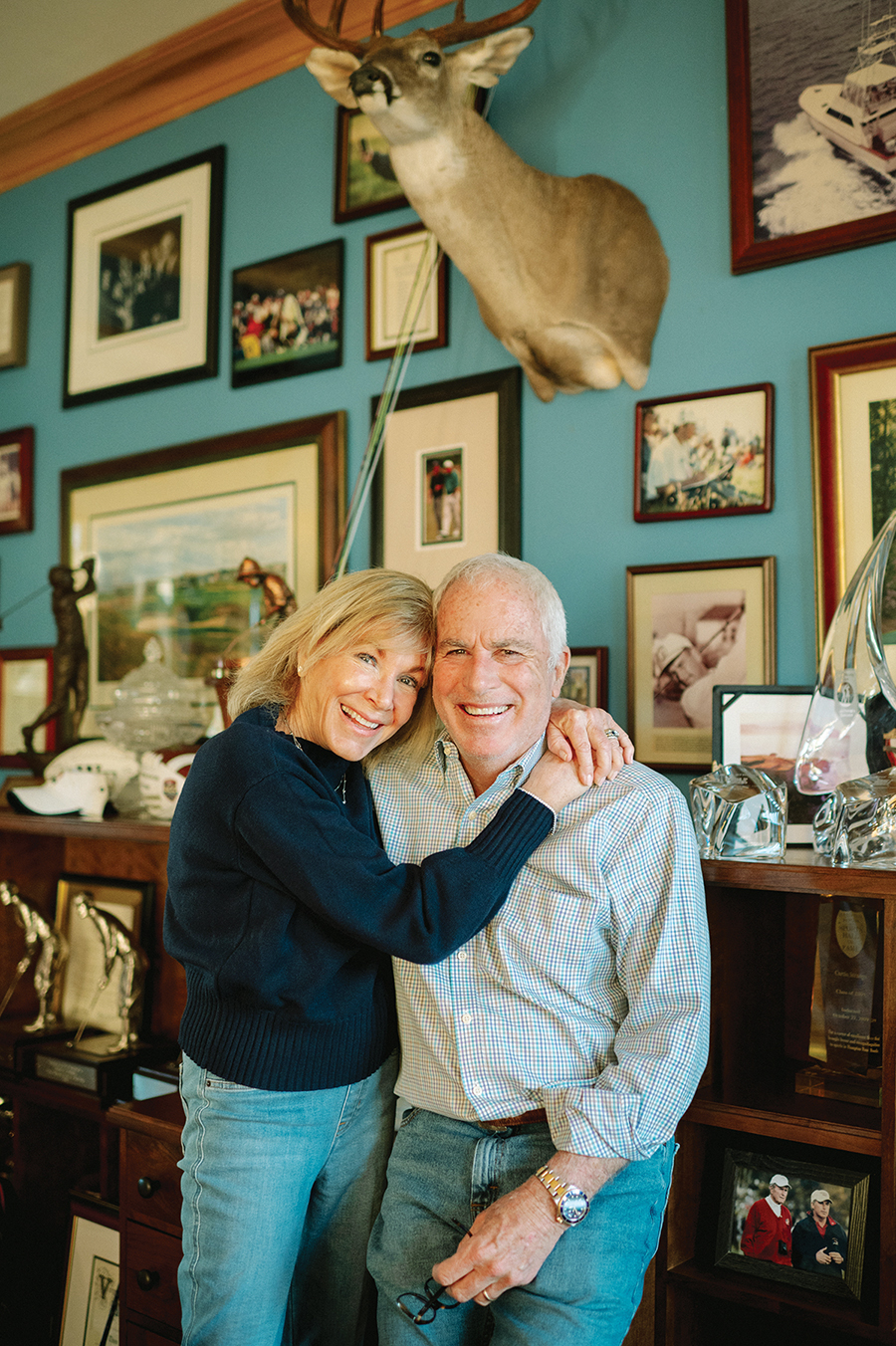
If the fishing adventures are winding down, so is the TV gig. And that’s OK. Strange doesn’t do shrines to the past. He has replicas of his Open trophies and one of the Ryder Cup given to him by the team he captained. There’s a copy of the scorecard when he shot 61 on the Old Course at St. Andrews, a record that stood for almost two decades. His locker at the new World Golf Hall of Fame in Pinehurst, where Allan lives, is understated.
Mostly now his biggest job is being a grandfather and, in that, he’s still following his father’s advice, trying to be the best. EB
Jim Moriarty is the editor of EastBound Magazine.