

By James Dodson
On a cool autumn morning not long ago, I set off for the small town of Tarboro in eastern North Carolina, the birthplace of Edward Harvie Ward, one of America’s great amateur golfers who scaled the heights of sporting glory only to fall from grace in a scandal that changed golf in America.
As I rambled east on old U.S. 70 — the way I once traveled to school at East Carolina University before the coming of faster interstates — I thought about the last time I saw Harvie on a lovely winter morning in 2003 when I dropped by the handsome home that he and wife, Joanne, shared on Blue Road in Pinehurst.
Harvie was dying of liver cancer. I was there to say goodbye — and offer an apology.
Owing to his advanced condition and my five years of work on Ben Hogan’s authorized biography that took longer than planned, we’d run out of time to properly research and write Harvie’s own tale of triumph, tragedy and rebirth. The book we envisioned was to be called The Last Amateur — Harvie Ward and the Scandal That Changed the Future of Golf in America.
I felt bad about that and told him so.
Harvie simply smiled. “Well, old sport, I guess our timing is just off a bit. Maybe someday.”
Almost two decades after that final conversation, I was headed to Tarboro in hopes of finding whatever details of his early life that might help jump-start greater public interest in this largely forgotten hero of American golf. In December 2025 Harvie would have turned 100, a milestone that warrants keeping his incredible story alive.
During the early 1950s, just as Ben Hogan’s star began to fade, Edward Harvie Ward rose out of the deep green fastness of eastern North Carolina to become the most admired and thrilling player in the game of golf.
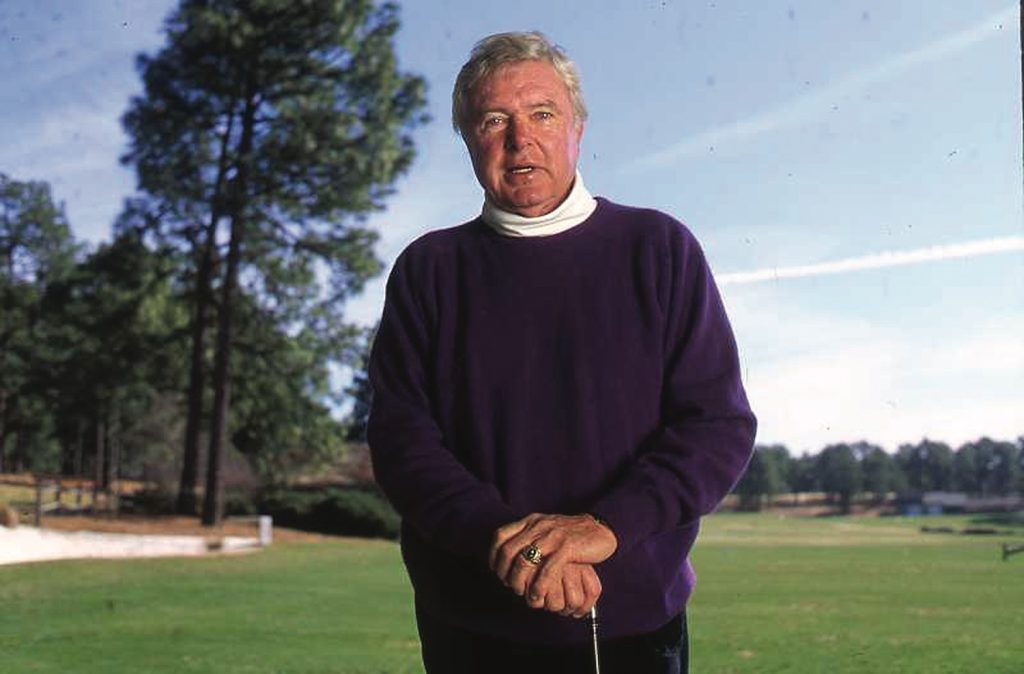
His springboard to overnight fame reads like a movie script. During the spring of 1948, cheered on by his Zeta Psi fraternity brothers and a rowdy crowd 1,000 strong composed of fellow students from UNC-Chapel Hill, wielding a wooden-shafted putter he’d found as a kid on a bench in the locker room of his father’s nine-hole golf club in Tarboro, Ward came out of nowhere to win the coveted North and South Amateur Championship on Pinehurst No. 2 in a 36-hole final with Frank Stranahan, the top amateur in the world at that moment.
Stranahan, scion of the Champion spark plug fortune, was reportedly so confident of beating the genial, smooth-talking college boy, he’d booked the Carolina Hotel’s dining room in advance for a victory dinner with dozens of his friends. At the turn of their match, Harvie heard Stranahan grumble to his caddie that if his opponent couldn’t putt, “he’d be just another good-looking college kid.”
Indeed, Harvie faced 18 “must make” putts — and holed them all with his beloved boyhood putter, closing out the world’s top-ranked amateur on the final hole. His ecstatic friends — many of whom had never set foot on a golf course before — lofted Harvie to their shoulders in celebration.
After college, while working as a stockbroker in Atlanta, Harvie captured the 1952 British Amateur Championship at Prestwick (beating Stranahan again, this time 6 and 5) and subsequently played on the first of three successful U.S. Walker Cups teams in 1953, 1955 and 1959, winning all six of his matches. After adding the Canadian Open title to his resume in 1954, he beat out a host of supremely talented amateurs in 1955 to win the U.S. Amateur Championship in a dominating 9 and 8 performance over Bill Hyndman Jr. at the Country Club of Virgina in Richmond. One year later, he defended his crown by dispatching gifted Chuck Kocsis 5 and 4 at the Knollwood Club in Lake Forest, Illinois — sparking talk of a new Bobby Jones on the rise.
With his movie star good looks, frat boy charisma and a playing temperament that never lost its cool, Ward quickly became the darling of the national sports media and the toast of American golf. Wherever he went, sportswriters exhausted themselves finding superlatives to describe his playing abilities, while adoring college girls trailed dreamily in his wake.
Herbert Warren Wind hailed Harvie as the most talented American player of the 1950s, and no less a golf legend than Byron Nelson proclaimed Harvie to be the “next Ben Hogan.” Keen observers of the game believed the affable son of a smalltown pharmacist was on track to claim a record third consecutive National Amateur title when unimaginable disaster struck.
Not long after Ward and his friend and fellow amateur Ken Venturi played an arranged private four-ball match against Byron Nelson and Ben Hogan at Cyress Point Golf Club that became the stuff of legend and a 1996 bestselling book called The Match, a surprise ruling by the United States Golf Association stripped Harvie of his amateur status for allegedly accepting expense money from sponsors to play in tournaments.
At the time, both Ward and Venturi made good money selling cars and auto leases for flamboyant Eddie Lowery in San Francisco, owner of the largest Lincoln-Mercury dealership in the country and a longtime member of the powerful USGA Executive Committee. The golf world remembered Lowery as the diminutive bucket-hatted tyke who caddied for Francis Ouimet at the U.S. Open in 1913, which Ouimet won in an 18-hole playoff with Harry Vardon and his traveling mate Ted Ray.
As Harvie saw it, while most tour pros of their generation were barely scraping by week to week, being paid a generous salary by Lowery to sell fleets of cars to potential corporate customers during the off-hours of important golf tournaments was a win-win situation. His amateur success even netted him 11 invitations to the Masters, finishing in the top 10 twice. In the process, Ward developed a close friendship with Augusta founder Bob Jones, who was widely known to fancy an eventual successor who would embody the ideals of amateur golf. Up to the moment the scandal broke, Harvie was considered a prime candidate.
The USGA, however, didn’t share Ward’s view of his sweetheart arrangement with Lowery, which they contended violated the spirit of amateurism, specifically a rule that prohibited any amateur from accepting financial help from anyone outside a player’s own family.
When the state of California investigated his boss for tax evasion, the USGA zeroed in on Lowery’s tax returns that seemed to suggest a cozy arrangement in which he wrote off the expense money paid to Harvie as “business travel” that coincided with Ward’s tournament play. There were a few other “irregularities” as well, but it appeared to the blue coats that Lowery was simply paying his protégé Harvie to play golf, including his jaunt over the pond to capture the British Amateur in ’52.
On June 7, 1957, Harvie faced a three-man tribunal in Chicago that included his longtime friend and mentor Richard Tufts (scion of Pinehurst’s founder James Walker Tufts and author of the respected Code of the Amateur), along with future PGA Tour honcho Joe Dey and a former U.S. Amateur champion named John Fischer. The hearing took all day.
Harvie politely spurned an offer by a celebrated legal eagle to represent him before the board, opting to face the music alone. “I went in there to tell them the truth and apologize for any mistake I might have unintentionally made,” he explained to me several decades later. “I was led to believe Richard Tufts was sympathetic to my situation. The last thing I expected was to have my amateur status yanked. I walked out of that place completely numb, with a burr up my tail. I decided I’d go back to San Francisco and play tennis and say the hell with golf.”
As he said this, he gave me a rueful smile, “Of course that was completely impossible. Golf was my whole life.”
The ruling — a one-year suspension from competition and Walker Cup participation — devastated Harvie’s life and career. As my colleague Bill Case pointed out in a brilliantly detailed piece in PineStraw magazine a few years back, the investigation against Lowery was eventually dropped, and Harvie’s amateur status was reinstated in 1958. But the damage was done.
“He clearly was not the same player,” Case wrote. “Though he managed to present his usual blithe front, his zest for the game had waned. The stigma of the suspension had clearly taken a toll.”
In 1958, Ward played poorly at the Masters and got knocked out of the U.S. Amateur in the third round. A year later he did manage to make the U.S. Walker Cup team, which included a young phenom named Jackie Nicklaus.
“Competing over the Honorable Company of Edinburgh Golfers’ majestic Muirfield links,” notes Case. “Ward prevailed in both his matches against the home team. Those wins were the 33-year-old’s last hurrah on the big stage.”
*
In every human tragedy there is an inevitable backstory. In Harvie’s case, many wise heads in the world of golf were convinced that he’d been made a sacrificial lamb for recent well-publicized failures by golf’s governing body in America to properly control amateur play and handicap policies at clubs across the country.
The most egregious example coincidentally took place at posh Deepdale Golf Club on Long Island (President Dwight Eisenhower was a member) the same summer — 1955 — Harvie won his first U.S. Amateur title at the Country Club of Virginia.
Somehow, still a mystery to this day, a pair of single-digit sandbaggers from Massachusetts managed to get into Deepdale’s annual high-flying Calcutta, claiming fraudulent handicaps of 17 and 18, respectively. The pair reportedly walked away with four grand apiece.
The national press had a field day when the scandal broke in early 1956. With mud on the face of America’s guardian of golf’s rules, the USGA launched a major crackdown on both how handicaps were governed and the manner in which Calcutta tournaments were staged and operated. Many clubs ended them. Others continued with stricter oversight. But the impact of the Deepdale scandal was sweeping and lasted for years, prompting a cautionary tale to be sent to the wider world of amateur golf. Many believed Ward’s fate became that message.
With his golf dreams in ruins, as he described it to me in 2003, Harvie climbed into a bottle and pretty much stayed there for the next 30 years, bitterly drinking away the most promising game since Bobby Jones.
After four failed marriages and a short-lived attempt to jump-start a late-in-life professional career in the early 1970s, followed by several years teaching the game at Grand Cypress in Florida (where he coached a cocky young player named Payne Stewart to his first U.S. Open victory at Hazeltine National Golf Club in 1991), Harvie met and married Joanne Dillon, a strong woman who steered him to sobriety and proposed moving “home” to Pinehurst, where Harvie first found his groove.
There, working for the family of Peggy Kirk Bell, he mentored many promising young players at Pine Needles Lodge and Golf Club and Mid Pines Inn and Golf Club, including a local youngster (and future U.S. Open winner) named Webb Simpson. When Payne Stewart returned to Pinehurst for the U.S. Open in 1999, his old teacher approached him on the practice tee before the start of play. “Payne ditched me after a few years of working together,” Harvie remembered. “But that was all in the past. It was a very emotional reunion. We hugged and I told him I was certain that he would win the Open that year.”
His prediction came true — making Stewart a golf immortal in the process.
“Looking back, coming to Pinehurst was the smartest decision I ever made — we made,” he told me as I prepared to say goodbye at his Carolina blue front door. He even gave me one of his old putters to give to my son Jack, who was just starting to learn the game.
“Without Joanne, none of this would ever have happened,” he insisted as he shook my hand and smiled. “Ol’ Harv is home. Sometimes in life, there is a happy ending.”
Ward passed away on September 4, 2004.
During the three years I worked with Arnold Palmer on his memoir, we had many conversations about his old friend and rival Harvie Ward, including how in the aftermath of Harvie’s fall from grace a generation of top amateurs jumped into professional golf to avoid his fate.
“What happened to Harvie changed golf,” he told me. “I think that’s when the professional game began to seriously overtake the amateurs in the public eye. In some ways, Harvie really was one of the last great amateurs who loved the purity of the game.”
Something else Arnold said stayed with me. “We were both smalltown fellows. Harvie loved that little town where he grew up the way I love Latrobe. He left Tarboro, but Tarboro never left him.”
*
Which explains why, two decades after our final conversation, I rolled into Tarboro eager to see what — if any — traces of Harvie Ward’s beginnings might remain.
The town itself was a pleasant surprise. Snuggled into a sweeping bend of the Tar River at the fault line of the western Coastal Plain, this handsome burg of 11,000 souls dates from 1760 and boasts the second oldest town common in America after Boston. Its spectacular 54-block historic district features more than 300 structures, evidence of its prosperous roots as a major river port before America was officially a nation. Not surprisingly, George Washington really did stop and sleep there during his famous Southern Tour in 1791. The town fired its only cannon to welcome the new president.
A local Renaissance man named Dave Sharpe, a retired banker of 35 years who runs tourism and development for Edgecombe County, gave me a driving tour of Tarboro’s flourishing downtown, river park and stately historic district, providing a rapid-fire summary of the town’s many annual festivals, historic churches and the largest common I’d ever seen — where the N.C. Symphony appeared in June and other events take place through summer and fall. Our final stop was to be the golf course where Harvie first played the game.
“History means a lot here,” Sharpe said. “The river’s access to the inner banks brought big-time wealth here early. But today we’re just a small Southern town where sports have always been big, especially 2-A high school football in the fall and the Tarboro River Bandits (wooden bat league) in the summer. I’m not sure if Harvie played baseball or football.”
I explained that Harvie did not play either sport owing to a prolonged inner ear condition called mastoiditis that denied him contact sports. For this reason, he gravitated to his father’s golf club early in life, first caddying for his dad, Harvie Sr., the town’s druggist, and later playing — reportedly barefoot at the start — at tiny Hilma Golf Club on the outskirts of downtown, a nine-hole layout with oiled sand greens that claimed to be the second oldest golf course in the state.
“While other contemporaries slid into the seasons as most boys do, football, basketball, baseball, et al., Harvie kept occupied by pounding golf balls,” Dick Taylor of Golf World wrote in a profile of Ward following his return to Pinehurst in 1976. Harvie’s struggles to adjust to his mastoiditis prompted his parents to place him under the “expert eye of Palmer Maples, pro at nearby Rocky Mount. He developed a superstar. Eight hours of daily practice,” Taylor wrote, “will do that.”
As a student at Virginia Episcopal School in Lynchburg, Harvie burst onto the scene by winning the Carolinas Junior Championship in 1941. Two years later, he enrolled at UNC-Chapel Hill. With a World War happening, following a stint in the U.S. Army, he returned to Chapel Hill planning to become a doctor, but finally settled on a business major that allowed him more freedom to play golf.
“Despite winning regional events,” Taylor noted with understated wit, “he was a relatively unknown quantity until the spring of 1948.”
I asked Sharpe if folks in Tarboro remember Harvie Ward.
“Oh, I think they do, especially the older ones. I’ve often thought that we ought to put up a historic marker for him downtown. He’s a big part of this town’s history and people are proud of that. You still hear folks mention him from time to time. He was a hero to Tarboro folks.”
His words reminded me of a conversation I had with Rusty Holderness, who along with his younger sister, Zelle, grew up in a house next door to Harvie’s on St. David Street.
“My parents and Harvie’s folks were good friends, part of a crowd that hung out at the golf club,” he told me the day I arrived. “Hilma Country Club was the center of the town’s social life. The clubhouse was a big wooden house with large porches where everybody in town socialized before or after golf. It burned down many years ago. But Tarboro is still the kind of place where, when you get married, everyone comes. And when you die, they also come.”
Zelle remembered her mother saying that local teenage girls hung around the Ward house hoping to catch glimpses of Harvie whenever he came back to town.
“He always came back to his hometown, no matter what, even when he became so famous and all that other business took place,” Curtis Edmondson, who married Harvie’s sister’s daughter, Emily Ward Habens, told me. “I can remember when he came out of Carolina and was the best amateur in the world like it was yesterday. For many years Harvie came back to play with me in the annual Edgecombe County Foundation Golf Tournament at Hilma Country Club. He loved that thing and raised a lot of money for it.”
Harvie once shot 55 for 18 holes, he added. “He loved that little course because he grew up there. People here loved him like a son. You never seen such a beautiful swing. I just wish he could have gone further in golf. No tellin’ what he could have done.”
Edmondson attended Harvie’s memorial at the Pinehurst Member’s Club in September 2004. “I still have the program from it. Dean Smith, you know, also attended the service. Lots of people from the golf world were there. A packed house.”
My tour of stately Tarboro with Dave Sharpe ended at what remains of the Hilma Country Club, which shut down several years ago and today is the site of attractive public rental housing. If you knew what you were looking at, though, you could see the bones of a once-loved golf course.
“Over there was the third fairway, and there’s the second clubhouse.” He pointed to a blue cinderblock structure that is now a private home. “Hilma kind of went downhill when other golf courses opened around here. But it was the place for Tarboro people forever.”
“Maybe you should put up a historic marker to remember it by,” I suggested. “And its most famous member.”
“That’s a fine idea,” he said.