
By Jason Frye
We live in a state of firsts. First in flight thanks to the Wright brothers and that relentless Outer Banks breeze. A 17-pound “yellow rock” fished from a Piedmont stream marked America’s first gold rush. And we’re first in freedom — yes, it’s more than a license plate slogan — thanks to Halifax, a tiny town on the banks of the Roanoke River that gave rise to the United States.
Sounds like quite the boast on the eve of our nation’s 250th birthday, but it’s true. On April 12, 1776, the Fourth Provincial Congress of North Carolina met in a Halifax tavern to ratify the Halifax Resolves, the first document calling for the Colonies to separate from British rule. With the ink still fresh on their signatures, delegates headed north to Philadelphia, where their fervor for freedom and the bold claims in the Resolves paved the way for the Declaration of Independence three months later.
How’s that for a first?
If all goes according to plan — and if the temperature and humidity in a special chamber in the brand-new Historic Halifax Visitor Center check out — the town will celebrate another first in 2026 when the Halifax Resolves come home for the first time since 1776. It’s one hell of an item to borrow from the Library of Congress.
As someone who has put a couple of hundred thousand miles on his car traipsing across North Carolina, the Halifax Resolves alone aren’t enough to fill a weekend there, but you can put together a fine getaway if you look beyond the town and venture into Halifax County. Make no mistake, though, you’ve got to start where the idea of the USA was born: Historic Halifax.
The visitor center gives you a glimpse into life in Colonial Halifax and the troubling times that led to the Resolves: no gold or silver currency, only IOUs for tobacco and naval stores shipped to England, and rising tensions between Colonists and King George III’s tax collectors, soldiers and sailors.
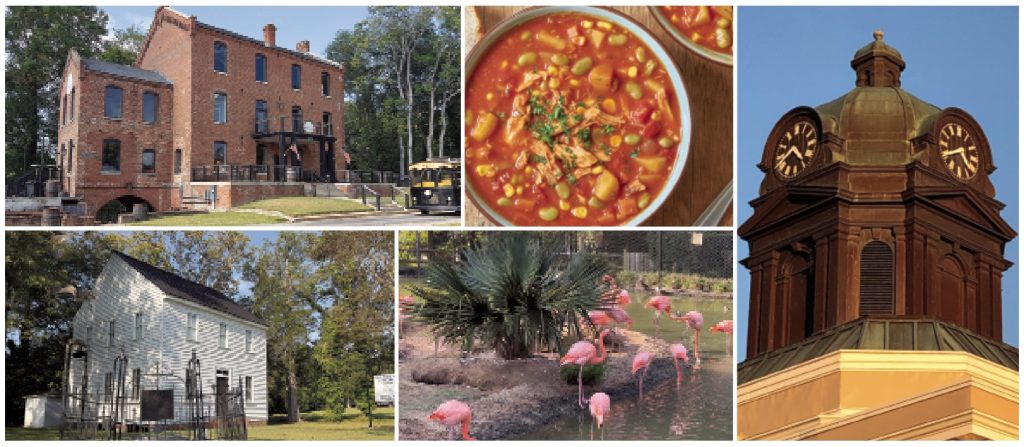
Across the visitor center garden, the yellow-slatted Eagle Tavern offers a deeper, humanizing look into the past through relics — like a silver sugar bowl used to serve the Marquis de Lafayette at a banquet, and gaming pieces common in Colonial taverns — and writeups on enslavement, tavern culture and the Resolves. Though Eagle Tavern (built in 1790) and the jail (1838) aren’t the tavern where the Resolves were written or the jail where Patriots served their penance, they give the place gravity, help anchor it in time for contemporary visitors.
If you want to feel like you’ve stepped from the 21st century into the 18th, head to Halifax on April 12, when a small army of Colonial re-enactors — costumed patriots and redcoats alike — occupy the site. These living historians show up a couple of times a year, but 2026 is a big one for Colonial buffs, so keep an eye on the historic site’s calendar to see when they’ll be back.
You can also step across Saint David Street to the Bradford Denton House. This Colonial home — brought to you by the Historic Halifax Restoration Association — is a restored wonder, the outbuildings are period-accurate reproductions, and you’ll find costumed interpreters and history enthusiasts here quite often. You might run into Jeff Dickens, peanut farmer, history buff and storyteller extraordinaire, if you’re lucky. Dickens has an incredible collection of Colonial-era relics on display (including the home itself, which he discovered beneath a mountain of viny growth in a farm field). His stories, and the tales told by his fellow HHRA members, expand the Halifax saga.
The Roanoke River flows past Halifax, and from Colonial days through the Civil War it was a critical trade route. Rocky outcroppings upstream form impassible rapids and gave the town of Roanoke Rapids its name. In the early 1800s, a canal provided a way around the rapids and eventually became North Carolina’s longest museum and a riverside walking path. Seriously, the Roanoke Canal Museum and Trail stretches from Roanoke Rapids to Weldon some 7 miles, giving the museum its odd superlative. You can catch a glimpse of the rapids at the Weldon end of the museum near one of the state’s best booze bottlers, Weldon Mills Distillery, and if you’re ready for a riverside ramble, park by Riverside Mill, a nearby antiques superstore, and make your way west on the gravel trail.
Weldon Mills Distillery has a monstrous lineup of 30 spirits. At the tasting bar, you can work your way through their bourbon, whiskey, rum, gin and tequila catalog. Each spirit comes in a flavor-infused variety (like a radioactive-green cinnamon vodka), but the straight versions let the spirits shine.
You may find spirits of another sort at Riverside Mill, where doubtless there’s a haunted item or two hidden among the antiques and tchotchkes inside. Just down the road in the town of Scotland Neck, you’ll find antiquarian objects of a different sort: rocks. The Rock Museum, part passion project, part mineral wonderland, is packed with some of the wildest rocks you’ll ever see — spiked and finned and oddly shaped, fluorescing under blacklight to reveal hidden colors. Goggle at these wonders and grab a pendant, ring or clutch of polished stones before heading down the road to Sylvan Heights Bird Park.
This east-of-95 road trip has a lot of ties to our collective past, including a look back in time at Sylvan Heights, where several species of birds remind us that these feathered friends (like the huge Abyssinian ground hornbills and a rhea tall enough to look you in the eye, outfitted with talons like a film-famous velociraptor) are among the closest relatives to dinosaurs on the planet. Other birds — turacos, the green-naped pheasant pigeon, and the big-as-a-Thanksgiving-turkey blue-crowned pigeon with its lacy cap of delicate feathers — shine with an opalescent radiance and surprise you with their range of calls and songs.
No road trip is complete without a good meal. In Scotland Neck, La Casetta serves up homey Italian and A&B Bar-Be-Que & Chicken sticks to Eastern N.C. traditions, but if you want to go real traditional and you’ve got a hankering for barbecue, you need Ralph’s in Weldon. Ralph’s has served up Eastern N.C. ’cue for more than seven decades, and the recipes and style of service — a small but mighty buffet — haven’t changed much in that time. Brunswick stew and banana pudding should bookend your meal, but in between you’ll have a hard time picking between the barbecue, the fried chicken and the fried vegetable sides.
So, it’s time to pack a bag, unfold your roadmap, and hit the highway. Halifax is calling.